
AI in sports games is often discussed in extremes.
Either it is presented as a breakthrough that will transform everything, or as a threat that will replace human talent overnight. In reality, the more interesting story is usually much more practical. In EA Sports FC, the real shift is not full automation, but selective automation inside a massive live-service production pipeline.
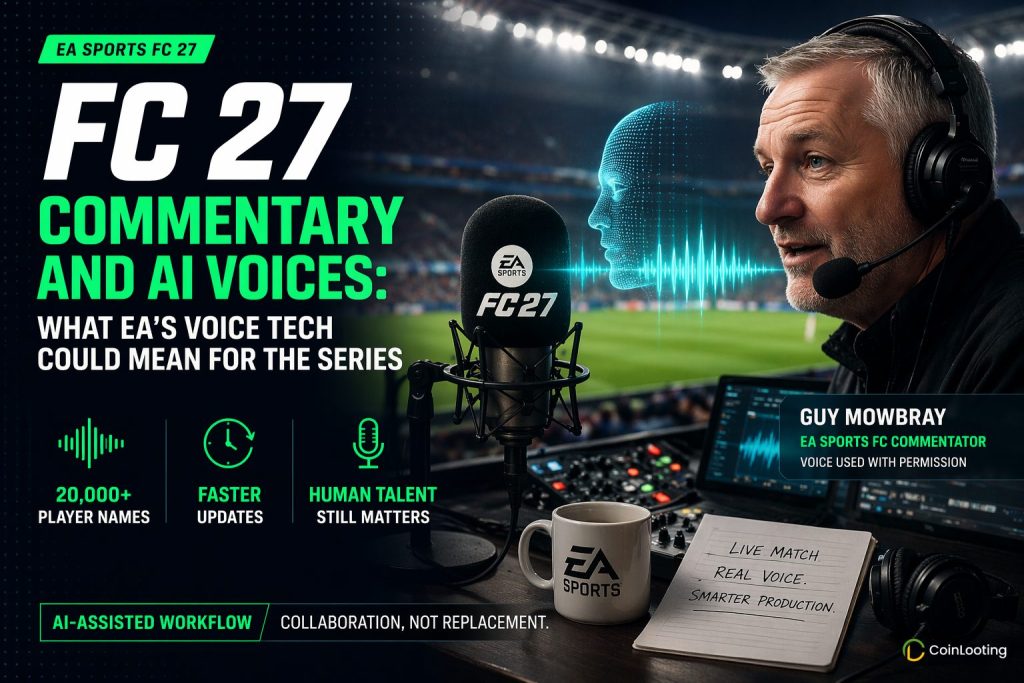
Recent reporting suggests that EA has been using AI-assisted voice technology for some commentary-related work, including certain player-name recordings in commentator Guy Mowbray’s voice, with permission. EA has also said that AI has long been part of its development process and described its use in commentary as collaboration with talent, not replacement.
That makes this an important FC 27 discussion point. Not because it confirms some dramatic commentary revolution, but because it shows how EA may be trying to expand presentation quality without removing the human layer that gives football broadcasts their authenticity. Even systems that seem far removed from match commentary, such as live-service content delivery or interest around FC 27 starter squad coins, belong to the same broader challenge: keeping a football platform fresh, scalable, and responsive across constantly changing player-facing systems.
Recommended Services


Why commentary is such a hard production problem
Commentary in a football game is not just a script.
It is a production challenge, a data challenge, a localization challenge, and a quality-control challenge at the same time.
A modern football title has to account for:
- thousands of players
- constant squad updates
- transfers and new competitions
- different match contexts
- multiple delivery styles
- many supported languages
That scale matters. A commentator is not just recording one clean version of a player’s name. The same name may need several versions depending on whether the player is receiving the ball, taking a shot, scoring, or being mentioned during build-up play.
This is exactly the kind of high-volume routine work where technologies like text-to-speech and voice cloning become attractive.
What EA appears to be doing
The current picture is narrower than the phrase “AI commentary” makes it sound.
What the available reporting supports is this:
- real commentators still record the core expressive lines
- AI assists with routine fragments
- voice usage happens with permission
- EA presents the system as support, not replacement
That distinction matters. It separates a fully synthetic commentary model from an AI-assisted workflow designed to reduce studio repetition.
A cleaner technical way to describe this would be:
- Text-to-Speech for generating spoken output from text
- Voice Cloning for reproducing a specific voice identity
- AI-assisted commentary workflow for the broader production setup
Why this makes business sense for EA
From a business standpoint, the logic is easy to understand.
EA runs a football platform that needs constant refreshing. Commentary is not recorded once and left alone. It has to keep up with database changes, new squads, updated names, live-service content, and ongoing seasonal support.
AI assistance helps EA in several obvious ways:
- less repetitive studio work
- faster maintenance of commentary coverage
- more consistent delivery across recording sessions
- easier support for a constantly changing player pool
That does not mean the creative cost disappears. Training, approvals, testing, rights management, and pipeline integration still require time and money. But once the system is in place, the cost of refreshing short routine lines can become much lower than fully manual production.
Traditional commentary vs AI-assisted workflow
| Parameter | Traditional approach | AI-assisted workflow |
|---|---|---|
| Coverage | Limited by commentator availability and studio time | Easier to extend for names and short routine lines |
| Consistency | Can vary between sessions | More stable tone and delivery |
| Emotional range | Strong in dramatic moments | Still weaker for expressive live-feeling lines |
| Update speed | Slower when databases change often | Faster for maintenance and refreshes |
| Cost profile | Ongoing manual recording effort | Higher setup cost, lower update friction later |
| Best use case | Core personality and big-match emotion | Names, variants, routine support lines |
The localization angle may matter even more
This is one of the most overlooked parts of the discussion.
For a publisher like EA, English commentary is only part of the challenge. The bigger scaling issue is localization. If AI-assisted voice workflows become reliable enough, they could help EA support more languages, refresh more pronunciations, and reduce gaps in smaller markets.
That could be especially valuable for:
- Polish
- Turkish
- Arabic
- smaller European language regions
- markets where full premium commentary support is harder to scale manually
This does not mean every language instantly gets equal treatment. But it does point to a strong long-term advantage: broader commentary coverage in regions that might otherwise receive slower updates or less depth.
The QA angle is where this gets serious
Using AI in commentary does not remove quality risk. It changes the kind of quality risk that has to be managed.
With a traditional workflow, the main issue is human variation and studio time.
With an AI-assisted workflow, the main concerns become:
- pronunciation mistakes
- incorrect stress or cadence
- unnatural delivery in context
- mismatch between human-recorded and AI-assisted lines
- edge-case failures with less common names
- outputs that sound fine in isolation but wrong during live gameplay
A mispronounced superstar name is not a minor issue. In a global football game, that can become a community talking point immediately.
If EA expands this type of system, it likely needs stronger audio QA pipelines, including:
- pronunciation validation
- comparison against approved voice references
- market-specific testing by language
- context testing inside real gameplay
- stricter sign-off for high-visibility players and leagues
In other words, AI does not reduce commentary complexity. It shifts more of that complexity into testing, monitoring, and approval.
What this could mean for FC 27
It would be a mistake to jump straight to “FC 27 will have fully AI-generated commentary.” The current evidence does not support that.
A more realistic expectation would be:
- broader player-name coverage
- faster maintenance of commentary libraries
- more stable voice delivery across updates
- subtle improvements in presentation depth
- better support for a live-service football model
There is also a quieter potential upside that is easy to miss: more context-aware name delivery. If these workflows improve, EA could eventually support more natural name variants across competitions, match states, or broadcast situations. That would not be a headline feature, but it would be a meaningful presentation upgrade.
The human layer still matters most
Commentary is performance, not just output.
Players do not only want correct names. They also want:
- timing
- tension
- emotional lift
- natural phrasing
- the feeling that a big moment sounds big
That is why the phrase “collaboration, not replacement” matters. It reflects a practical boundary between production efficiency and broadcast authenticity.
The current direction appears to recognize that some parts of commentary can be optimized, while others still depend heavily on human instinct and performance.
The rights-management question will only grow
This is where the topic becomes bigger than game development.
Once voice cloning becomes part of a commercial workflow, several questions follow:
- what exactly is the commentator licensing?
- is payment session-based, usage-based, or royalty-based?
- can the cloned voice be reused across titles?
- what approval rights remain with the commentator?
- what happens if the relationship changes later?
The available reporting confirms permission in this case, but it does not publicly explain the full contract model. That matters, because voice rights are becoming one of the most important issues in AI-era media production.
A realistic five-year view
Over the next five years, the likely direction is not a simple human-versus-AI swap.
It is a layered model:
- humans handle tone, identity, and premium lines
- AI handles volume and routine maintenance
- localization expands through assisted workflows
- QA becomes more software-driven
- rights management becomes more formalized
If that happens, the winners will not be the companies that remove people fastest. They will be the companies that combine synthetic efficiency with human credibility without making the final experience feel artificial.
Final take
The real significance of this story is not that EA has “put AI into commentary.”
It is that EA appears to be treating commentary as infrastructure.
That means:
- some parts can be automated
- some parts still rely on human talent
- and the competitive advantage comes from managing both well
For FC 27, the most realistic takeaway is not a dramatic voice-tech overhaul. It is a quieter shift toward more scalable, more maintainable, and more technically managed commentary production.
That may not sound as flashy as a new game mode, but for a live-service football series, it could matter just as much over time.
💡 Quick Take: Efficiency vs Authenticity
AI in FC is not mainly about replacing commentators.
It is about removing dead zones in the production pipeline: names, variants, and routine maintenance work. The real challenge is making that efficiency invisible enough that players still hear a football broadcast, not a synthetic system.