
LOTRO - The Lord of the Rings Online
Showing the single result
LOTRO Services for The Lord of the Rings Online
The Lord of the Rings Online (LOTRO) is a long-running MMORPG developed by Standing Stone Games. Set in J.R.R. Tolkien’s Middle-earth spans the timeline of the War of the Ring and beyond, with regular expansions, seasonal events, and a player-driven economy. Players can focus on the epic story, group raids, crafting, festivals, housing, or PvMP, and most veterans rotate between several at once.

Patch
The Lord of the Rings Online runs on the Kingdoms of Harad expansion cycle, which raised the level cap to 160 and added the Mûr Ghala region with four new zones (Adagîm, Idagâl, An Shêru, and Kighân). Standing Stone Games supports the expansion through a series of free updates that extend both story content and endgame systems.
Major additions:
- The Folly of Nagakhêdi raid, the capstone group content for the expansion, available across multiple difficulty tiers up to T3.
- The Hatokáli Fells (Pahar Hatokáli), the southernmost zone of Mûr Ghala, with end-cycle questing for level 160 characters.
- Rivendell Steadings, a premium housing neighborhood set in the mountains west of Imladris.
- Ekal-nêbi, the Fallen Palace, a 6-player instance in Emax Dûl.
- The 19th Anniversary event with new missions, cosmetics, and rewards.
- UI scaling support, plug-in API improvements, and ongoing class balance adjustments.
For the full history, see the official LOTRO patch list.

Progression Paths in LOTRO
LOTRO does not push players down a single track. Instead, the game offers parallel progression systems, and most players move between them depending on mood and goals.
The Epic Story forms the spine of the game. It runs in volumes and books across every expansion, telling the canonical journey of the Free Peoples through Middle-earth. New players typically start here at level 1 and move forward through the main narrative.
Quests and Deeds fill the world outside the Epic. Most zones contain dozens of side quests and accompanying deeds, which reward Turbine Points, virtues, titles, and reputation with in-world factions.
Instances and Raids form the group endgame. Six-player instances run on weekly lockouts, while raids (such as The Folly of Nagakhêdi) scale up to twelve or twenty-four players depending on the era. Difficulty tiers go up to T3 or higher, with progression-style mechanics and dedicated loot tables.
Missions and Delvings are bite-size repeatable instances designed for solo or small-group play. Delvings layer modifiers on top of standard content for higher rewards, similar to Greater Rifts in other MMORPGs.
Legendary Items are the long-term gear customization layer. Each character equips a Legendary Weapon and a Legendary Class Item, then tunes them with Traceries that grant skill buffs and stat bonuses. The Legendary Item Reward Track is a seasonal account-wide progression system that runs roughly every three months and rewards Traceries, Embers of Enchantment, and crafting materials.
Crafting and Gathering form a full parallel game. Vocations combine three professions, and Disciples of the Hand and Land drive most of the Auction House economy.
PvMP (Player versus Monster Player) lets players fight as creatures of Mordor against the Free Peoples in the Ettenmoors zone. It is one of the oldest open-world PvP systems still active in the genre.
Festivals, Housing, and Cosmetics form the long-term collection layer. Festivals rotate through the year (Spring, Summer, Anniversary, Farmers Faire, Yule), and housing has expanded across multiple neighborhoods, most recently the Rivendell Steadings.
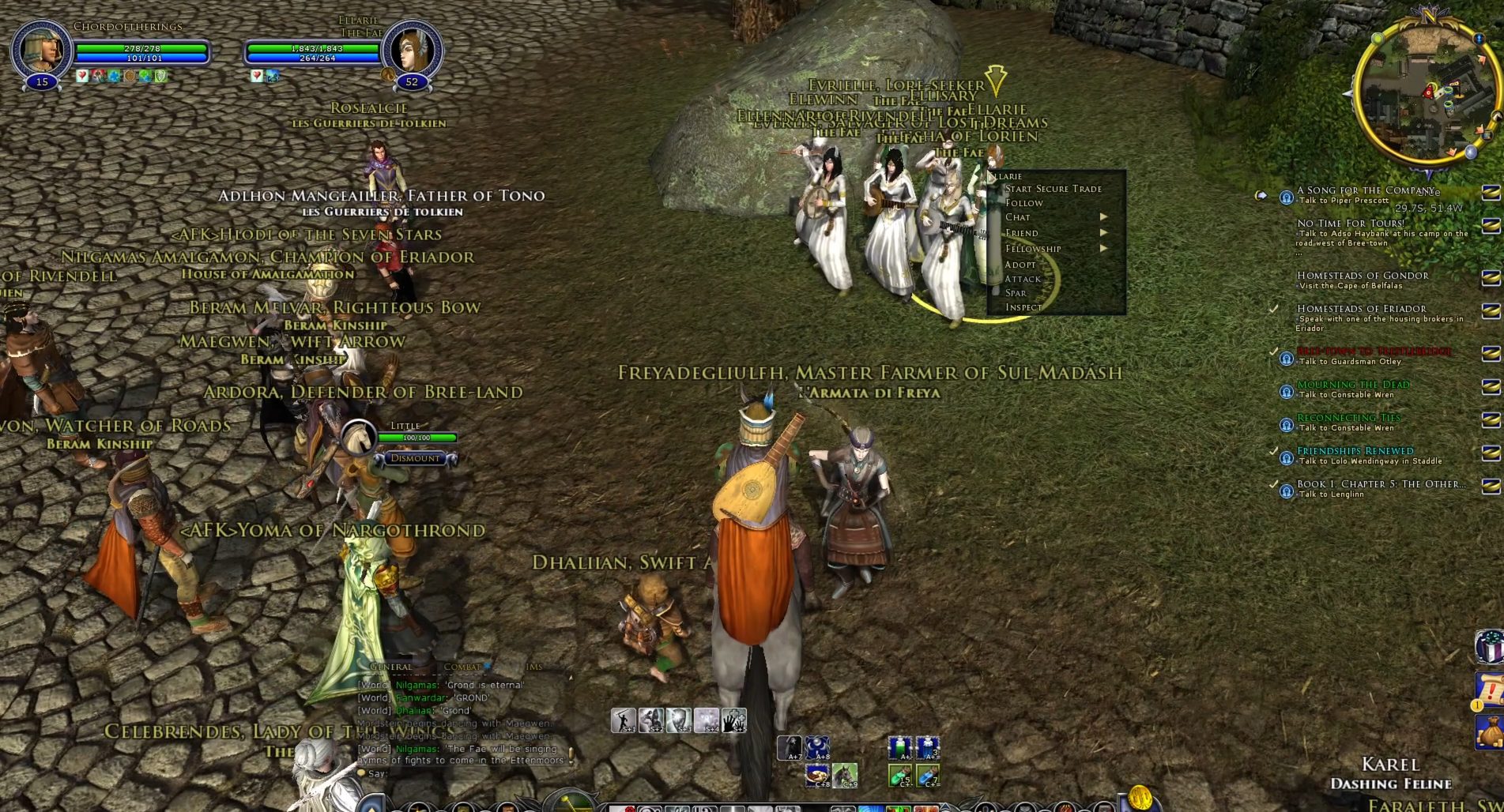
Economy and Auction House
LOTRO’s economy is fully player-driven on each server. Crafters and gatherers feed the Auction House, and prices respond to expansion cycles, server population, and seasonal demand. Whenever a major update lands, the materials and recipes that matter shift along with it.
Server population also shapes the experience. After the 2025 migration to 64-bit servers and the regional consolidation, larger Worlds tend to keep deeper supply and tighter prices, while smaller Worlds and Legendary servers often see sharper swings right after an update. Importantly, the Auction House operates per server, so your trading scope is defined by where your character lives.
Beyond Gold, LOTRO uses several other in-game resources: LOTRO Points for the in-game store, Mithril Coins as a premium paid resource, barter tokens for specific content types, and Ancient Script for Legendary Item upgrades. For server-specific Gold details, see our LOTRO Gold page.
Servers and Regions
LOTRO runs on a set of 64-bit Worlds following the 2025 consolidation. Worlds are split between two physical regions, and characters are typically locked to the region group they were created in.
- EU Worlds: Grond, Orcrist, Meriadoc (RP), Mordor (Legendary)
- US Worlds: Sting, Glamdring, Peregrin (RP), Angmar (Legendary)
The RP designation on Meriadoc (EU) and Peregrin (US) signals that those Worlds host stronger roleplay communities. Standing Stone Games no longer enforces unique RP rules, but the player culture remains distinct.
The Legendary servers Mordor (EU) and Angmar (US) are Veil of the Nine fresh-start Worlds. They limit content access and roll forward through the expansions over time, giving players a way to relive the LOTRO progression journey from the start.
Cross-region transfers between EU and US Worlds remain unavailable due to long-standing technical limitations, but transfers within a region are supported.