
PoE 2 Return of the Ancients Guide: 0.5 Day-One Plan for Runes of Aldur
Updated: May 12, 2026 – pre-patch-notes version. Full Patch 0.5 notes are scheduled for May 21 PDT, so final build rankings, exact skill values, and farming priorities may change before launch.
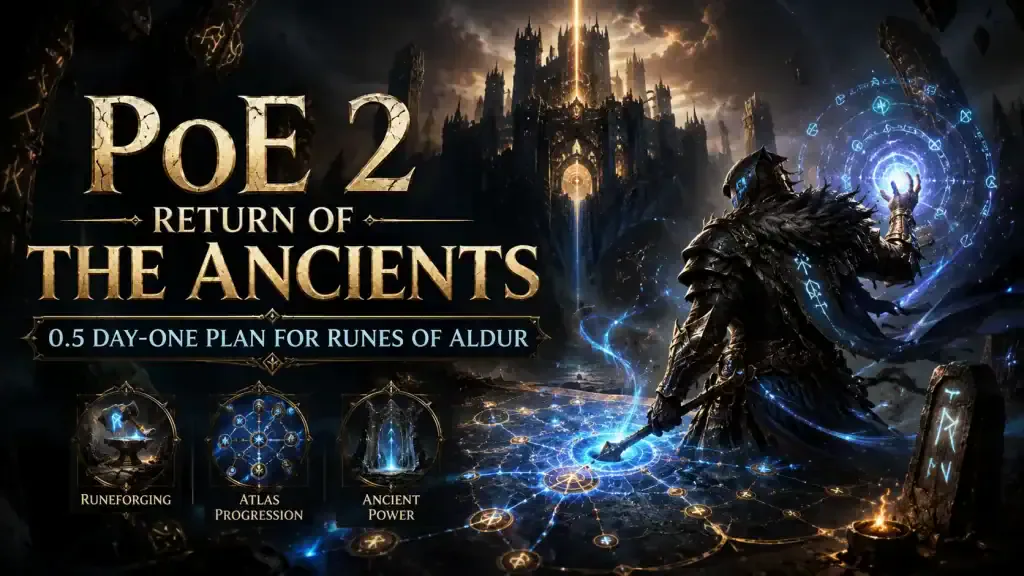
Path of Exile 2 Patch 0.5, Return of the Ancients, is the last major Early Access update before the road to 1.0. It brings the Runes of Aldur league, a fresh economy, two new Ascendancy classes, a rebuilt endgame, Fortress progression, Runeforging, Runic Ward, new Kalguuran skills, core Fate of the Vaal systems, and a Standard Atlas reset.
GGG confirms in the official Return of the Ancients FAQ that the update launches on May 29, 2026, at 1 PM PDT across supported platforms. The same FAQ confirms that existing Path of Exile 2 players only need to download the update, Runes of Aldur requires a new character, and Standard Early Access Atlas progress will reset.
This guide focuses on the first decisions that matter: how to start Runes of Aldur, which new systems deserve attention, what changes in the Atlas, when to wait for patch notes, and what mistakes can cost you currency during the first days.
Recommended Services


Quick Answer
Best first move: create a fresh Runes of Aldur character, pick a flexible league starter, avoid expensive unique-item decisions before the May 21 patch notes, learn the Fortress route early, and treat Runeforging as a major currency-saving system.
Most useful day-one priorities:
- Choose a starter that works without rare uniques. Patch notes may change skill values, scaling, and item demand.
- Do not spend Divine Orbs on Unique items too early. Runeforging can reroll affixes when upgrading many low-level Uniques.
- Push toward the Fortress after campaign progression. It is tied to Atlas Passive Tree progress and the new endgame route.
- Learn Runic Ward and Kalguuran skills early. They affect defense, gearing, and class-agnostic skill planning.
- Do not plan bosses around old random key logic. Patch 0.5 moves endgame boss access toward dedicated questlines.
What Return of the Ancients Adds in Patch 0.5
Return of the Ancients is not just a league reset. It changes how players move from campaign completion into endgame, how league mechanics connect to the Atlas, how some defensive layers work, and how old Unique items can stay relevant through new crafting systems.
| Confirmed 0.5 Feature | What Changes | Why It Matters on Day One |
|---|---|---|
| Runes of Aldur league | Fresh start with league-only mechanics, rewards, bosses, and challenges | Old stash value does not carry into the new league economy |
| Spirit Walker and Martial Artist | Two new Ascendancy classes enter the build pool | Starter and reroll plans may shift after patch notes |
| The Fortress | New central endgame structure tied to map mechanics and boss progression | Ignoring it can delay Atlas Passive Tree progress |
| Atlas rework | Atlas flow, questlines, bosses, and passive choices are rebuilt | Old mapping habits may no longer fit the new route |
| Runic Ward | New defensive resource added through Runeforging systems | Defensive planning may include gear-based ward layers |
| Kalguuran skills | New class-agnostic skill system linked to Runes of Aldur tech | More build options beyond standard gem planning |
| Unique Runeforging | Many low-level Uniques can scale upward through Verisium and new materials | Early Divine Orb spending on Uniques can be wasteful |
| Fate of the Vaal core | Temple of Atziri systems move into the base game | Vaal-related progression stays relevant beyond 0.4 |
| Build Planner | In-game build import and passive guidance arrives | Players can follow creator builds with less manual setup |
| QoL updates | Fragment Tab support, Atlas search, trade price checks, tracking tools | Less time lost to stash, pricing, and route management |
The strongest approach is to treat 0.5 as a semi-reset of player habits. Even experienced PoE 2 players need to relearn the route from campaign to Atlas goals.
Runes of Aldur League Start: What to Know First
Runes of Aldur is the new league for Patch 0.5. To enter it, create a new character and select the Runes of Aldur banner during character creation. Standard Early Access characters remain playable, but they do not enter the Runes of Aldur economy.
The new league matters for three reasons:
- Fresh economy: players start without old league items, so early trade prices can move sharply.
- League mechanic access: Runes of Aldur adds its own mechanics, bosses, resources, rewards, and challenges.
- Exclusive cosmetic goals: completing 8 Runes of Aldur challenges unlocks pieces of the Knight of Aldur Armour Set.
The league’s core fantasy is built around ancient Kalguuran technology, rune crafting, Verisium, and risk-reward encounters. Early coverage of the reveal points to Farrow and Ezomyte Remnants as part of the league flow, where rune choices can empower both the player and enemies. That makes Runes of Aldur more than a simple reward chest mechanic: it affects how much risk you accept while leveling, farming, and pushing maps.
The best launch mindset is simple: do not overbuild around perfect theorycrafting. Build around survival, stable damage, and upgrade flexibility
Two New Ascendancy Classes: Spirit Walker and Martial Artist
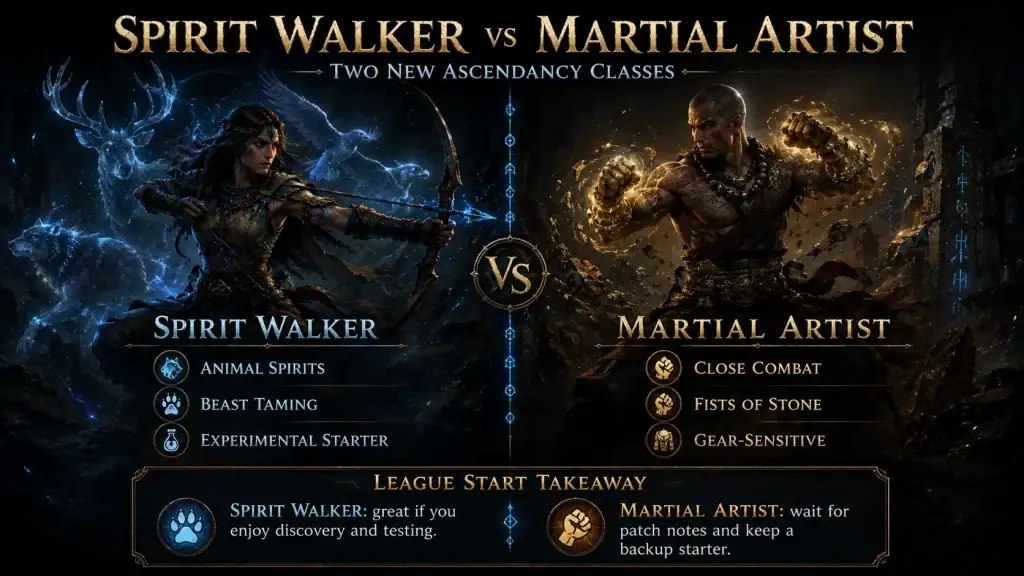
Patch 0.5 adds two Ascendancy classes that will shape league-start curiosity.
Spirit Walker
Spirit Walker is tied to the Huntress and channels animal-spirit fantasy. Early reveal coverage describes it as an Ascendancy built around spirit interaction and beast-taming tools, including the ability to tame certain beast bosses as active allies.
For league start, Spirit Walker looks attractive for players who want a fresh playstyle rather than a solved meta pick. The risk is that new Ascendancies often need real launch testing. Numbers, pet behavior, survivability, scaling, and boss performance matter more than reveal footage.
Best first-week approach: pick Spirit Walker if you accept discovery and possible respec pressure. Avoid it if you need the safest campaign-to-maps route.
Martial Artist
Martial Artist is tied to Monk-style gameplay and focuses on fist-based combat tools, including systems such as Fists of Stone and Hollow Form in early reveal breakdowns.
Martial Artist may suit players who like close-range combat, mobility, and active skill rotations. The launch risk is similar: melee-adjacent builds can feel incredible with tuned numbers, but rough if defenses, recovery, and boss uptime are weak.
Best first-week approach: wait for patch notes before calling Martial Artist a safe starter. Keep a backup build ready if its early gearing looks expensive.
The Fortress and the New Atlas Route
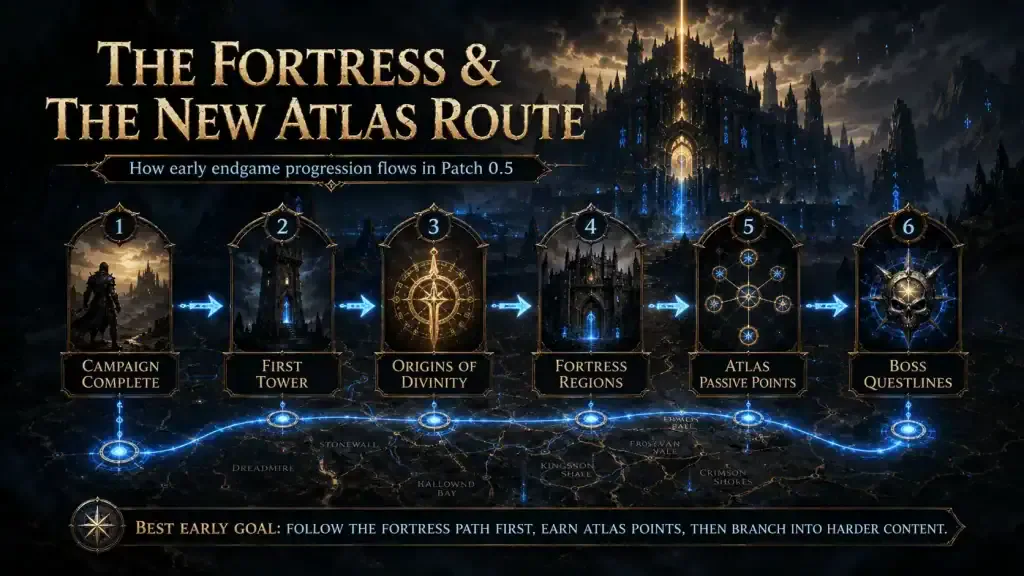
The Fortress is one of the central parts of Patch 0.5 endgame. It appears in the Atlas and acts as a major progression structure with special maps, modifiers, Azmeri spirit hunts, and a boss path at the center.
This matters because the Atlas is no longer just an open sprawl of map nodes. Patch 0.5 adds more structured goals, questlines, and visible routes through league mechanics. Coverage from Mobalytics describes the new endgame as an Atlas with specific points of interest, questlines for mechanics such as Breach, Delirium, Abyss, Expedition, and Ritual, plus Fortress progress that unlocks Atlas Passive Points.
How to Approach the Fortress Early
- Finish campaign with stable defenses. Fortress maps and early Atlas content will punish weak resistances and poor recovery.
- Do not rush every mechanic at once. Pick one route, learn it, then branch out.
- Treat Fortress progress as Atlas progress. It is not side content if it gives passive points and unlocks future pathing.
- Watch boss access rules. Patch 0.5 pushes endgame bosses through questlines rather than relying on old first-attempt key drops.
- Do not copy old Atlas trees blindly. The new Atlas structure changes how rewards and difficulty stack.
The old habit of wandering until profitable content appears will be weaker here. Patch 0.5 gives players clearer goals, so the best route is to follow progression, earn passive points, then specialize.
Atlas Passive Tree, Masters, and Boss Progression
The Atlas Passive Tree receives a major rebuild in Return of the Ancients. Mobalytics reports that passive points are unlocked through the new questlines, with reworked mechanic trees and more player control over endgame direction.
Patch 0.5 also adds Masters of the Atlas. Early reveal coverage names Jado, Hilda, and Doryani as master-style systems connected to endgame modifiers and progression choices. These systems appear to affect how you shape maps and the risks you accept.
What This Means for First-Week Mapping
- Atlas points are progression rewards, not just passive bonuses. You earn them through specific routes and questline steps.
- Bosses have clearer access paths. First attempts are tied to dedicated questlines rather than pure random key luck.
- Mechanic choice matters earlier. Breach, Delirium, Ritual, Expedition, Abyss, Fortress, and Temple systems can all compete for time.
- Multi-choice nodes can punish lazy planning. If nodes let you buff yourself, the boss, rewards, difficulty, or mechanic intensity, the wrong choice can slow progress.
During the first week, prioritize a stable Atlas path over theoretical maximum profit. Clearing content reliably is more valuable than stacking difficulty you cannot handle.
Runic Ward, Verisium, and Unique Runeforging
Runeforging may become one of the most practical systems in Return of the Ancients. Reveal summaries describe Verisium as a new crafting resource gained from Runes of Aldur encounters. It can interact with new crafting options, including Runic Ward and Unique item upgrading.
What Runic Ward Does
Runic Ward is a new defensive layer added through Runeforging. Mobalytics describes it as a resource that protects you after losing all life. This means gear can carry a defensive mechanic that changes how risky encounters feel, especially when enemies are empowered by rune choices.
Do not treat Runic Ward as a replacement for life, resistances, recovery, and avoidance. Treat it as an added layer that may buy time during lethal hits.
Why Unique Runeforging Matters
Sportskeeda and other reveal recaps describe Unique Runeforging as a way to scale many low-level Unique weapons upward with Verisium and related materials. The key catch: upgraded Uniques may reroll affixes.
That creates a major first-week rule:
Do not spend expensive Divine Orbs perfecting a Unique before you know whether you will Runeforge it
If Runeforging rerolls the item anyway, early Divine spending can be wasted. This is one of the most practical currency-saving lessons in Patch 0.5.
Day-One Crafting Rule
Use currency to solve immediate blockers first:
- weak weapon damage
- missing resistances
- poor movement speed
- low life or recovery
- build-enabling item gaps
- runeforging plans after you know the item path
Expensive perfection can wait. Early survival and clear speed matter more.
Reworked Core Mechanics: Breach, Delirium, Ritual, Expedition, and More
Patch 0.5 does not simply add a new league and leave old mechanics untouched. Major endgame mechanics are being reworked so they fit the new Atlas route and questline model.
Breach
Breach gets new progression through Keepers of the Flame and more intense Breach-style encounters. The key day-one question is whether your build can handle dense waves without losing control of positioning.
Delirium
Delirium receives clearer tracking, including a visible depth-style progress bar in reveal coverage. That makes it easier to judge how far you are pushing and when the encounter becomes too dangerous.
Ritual
Ritual updates appear to make tribute rewards more readable and stronger, with reveal coverage pointing to better unique and omen access. For early mapping, Ritual may reward patient players who can handle repeated arena pressure.
Expedition
Expedition expands through island-style map flow and new Kalguuran boss targets. Builds with strong area control, mobility, and safe damage windows may handle it better during the first week.
Fate of the Vaal and Temple of Atziri
Fate of the Vaal mechanics from the 0.4 cycle move into the core game. The cleaner way to describe this is: Temple of Atziri becomes permanent endgame content with its own place in the Atlas structure and progression logic.
This matters for currency because Temple systems, Runeforging, Atlas choices, and new crafting routes can create real demand shifts. The exact market impact depends on 0.5 tuning, but players should expect crafting resources and upgrade currencies to move differently from the previous cycle.
Build Planner and Quality-of-Life Changes
One of the strongest player-facing additions in Patch 0.5 is the in-game Build Planner. PCGamesN reports that players will be able to import build files directly into Path of Exile 2, with passive tree highlights, skill and support gem recommendations, and notes for item slots.
For new players, this reduces setup friction. For experienced players, it makes creator builds easier to test without alt-tabbing through several tools.
Other useful QoL additions include:
- Fragment Stash Tab support for Path of Exile 2
- Atlas search for finding map goals more easily
- Shift-Alt trade price checks for faster item valuation
- Pinned Tracking Scrolls for cleaner goal tracking
- Campaign guidance improvements for players who get stuck during progression
These changes will not make a weak build strong, but they can reduce time loss during campaign, trade, stash sorting, and Atlas planning.
Day-One Checklist for Runes of Aldur
Use this checklist before launch and during the first hours of the league.
Before Patch Notes
- Pick two possible starters. Keep one main plan and one backup.
- Avoid expensive item commitments. Full numbers are not final until patch notes.
- Study the new systems, not just builds. Fortress, Runeforging, Runic Ward, and Atlas questlines affect everyone.
- Prepare trade priorities. Know which item slots fix your build first.
- Do not assume old Atlas routes still work. Patch 0.5 changes post-campaign structure.
After Patch Notes on May 21 PDT
- Check your skill gems and support gems. Damage, costs, scaling, and availability can change.
- Check Ascendancy nodes. Spirit Walker and Martial Artist may shift starter choices.
- Check defensive layers. Runic Ward may change gearing, but it will not remove basic defense needs.
- Check crafting notes. Runeforging details decide whether some Uniques are worth buying early.
- Update your Atlas plan. Boss access and passive point unlocks matter more than old map habits.
During Launch Day
- Create a Runes of Aldur character. Select the correct league banner.
- Level with defense checks. Fix resistances, recovery, and movement speed before maps.
- Learn the league mechanic early. Identify when rune rewards justify extra danger.
- Push toward structured Atlas goals. Fortress and questline progress should guide early mapping.
- Spend currency only on real blockers. Do not buy hype items that do not solve your build’s current problem.
Patch 0.5 Mistakes That Can Cost You Time or Currency
| Mistake | Why It Hurts in 0.5 | Better Move |
|---|---|---|
| Spending Divine Orbs on a Unique before Runeforging | Runeforging may reroll affixes when scaling the item upward | Wait until you know the item’s upgrade path |
| Ignoring the Fortress | Fortress content is tied to endgame progress and Atlas Passive Points | Treat it as part of the main Atlas route |
| Following old boss-key habits | Boss access shifts toward questlines for first attempts | Follow the new questline flow |
| Copying a starter before patch notes | Skill values, supports, and Ascendancy nodes can change | Keep one starter and one backup |
| Taking risky Atlas choices too early | Multi-choice nodes and harder mechanics can slow weak builds | Build stable currency first, then scale difficulty |
| Treating Runic Ward as full defense | It is an extra layer, not a full build foundation | Keep life, recovery, resistances, and movement strong |
| Farming every mechanic at once | Patch 0.5 has too many systems to learn at the same time | Pick one route, learn rewards, then branch out |
The best first week usually belongs to players who stay flexible. Patch 0.5 rewards knowledge, but it punishes early overconfidence.
When CoinLooting Can Fit Into Your 0.5 Progression
Return of the Ancients has a fresh economy, new crafting pressure, Runeforging costs, early map upgrades, and likely price swings around league-starter gear. If your character reaches maps but lacks currency for key upgrades, PoE2 currency can support trade, crafting, and recovery from a rough start.
Keep this as a practical option, not the core plan. The best use of currency in the first days is fixing real blockers: weapon damage, resistances, movement speed, life, recovery, and essential build items. Players planning bigger upgrades later can compare market needs around PoE 2 Exalted Orb and PoE2 Divine Orbs once the league economy settles.