
WoW Retail Economy Guide: How Gold Supports Progress in Modern WoW
This WoW Retail economy guide explains how gold supports progression, professions, and Auction House decisions in modern WoW.
Why Gold Matters in WoW Retail
In modern WoW Retail, gold is tied to progress far more closely than many players expect. It is no longer just a side resource for mounts, vanity items, or casual spending. In the current Retail structure, players constantly use gold for consumables, enchants, gems, profession materials, crafted gear, and Auction House purchases that support raids, Mythic+, PvP, and alt progression. Blizzard’s The War Within Season 2 also reinforced that cycle by adding a new raid, new Delves, an updated Mythic+ rotation, and a new PvP season, all of which increase demand for preparation and repeat spending.
That is why many players feel short on gold even when they play regularly. The problem is often not a lack of effort. The real issue is that they spend time in ways that do not match how the Retail economy works. Some methods are safe but slow. Others are highly profitable but depend on timing, planning, and market awareness. The players who stay comfortable usually stop treating gold as a side activity and start treating it as part of their weekly progression.
The Two Sides of the Retail Economy
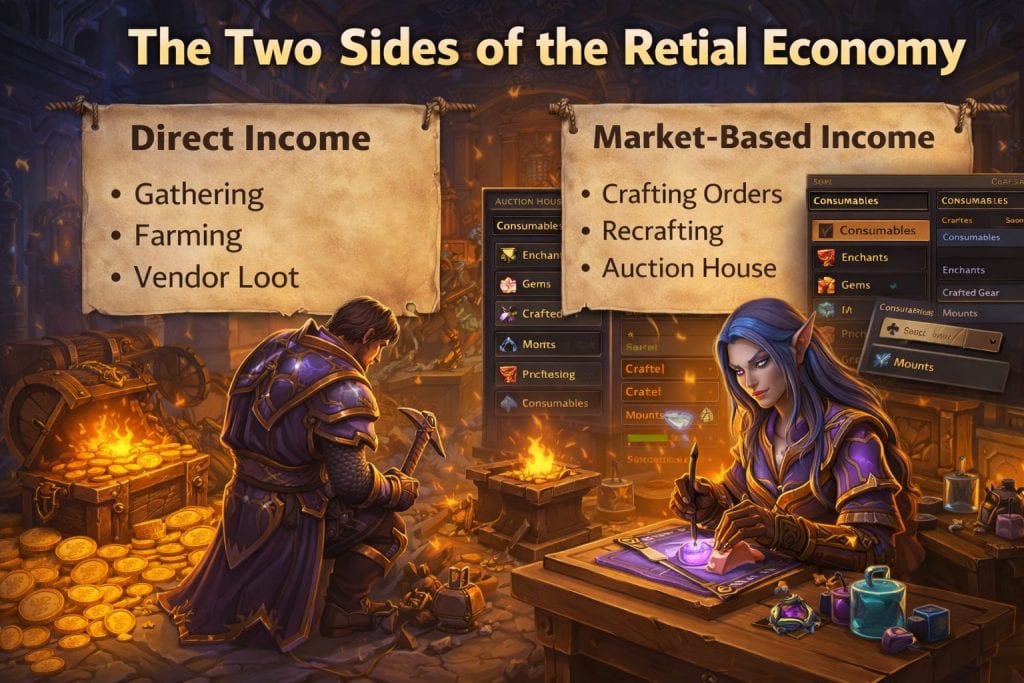
Direct income
The first side of the WoW Midnight economy is simple and predictable. You gather herbs, mine ore, farm mobs, loot items, and sell what you collect. This is still the easiest entry point for players who want reliable income without much risk. It works because active players and crafters always need raw materials for consumables, enchants, gems, and other profession outputs. In a live seasonal environment, that demand keeps returning.
Direct income is useful because it has a low barrier to entry. You do not need a big gold reserve, a deep understanding of market pricing, or a complicated setup. You just need consistency. That is why gathering remains one of the best starting points for players who want to build a stable gold base.
Market-based income
The second side of the economy is where Retail becomes more strategic. Here you are no longer making gold only from what you loot. You are making gold from what players need next. Blizzard’s profession overhaul introduced systems such as Crafting Orders and recrafting, which made professions much more connected to progression and created a structured economy around crafted items. Crafting Orders let players request recipes through a dedicated interface, while recrafting allows crafted gear to be improved instead of replaced from scratch.
This matters because it changed the role of professions. They are no longer just background content or a side hobby. They now sit directly inside the gearing cycle. That creates better opportunities for players who understand demand, margins, and timing. It also means that careless crafting can waste gold much faster than careless farming.
How Players Usually Build Gold
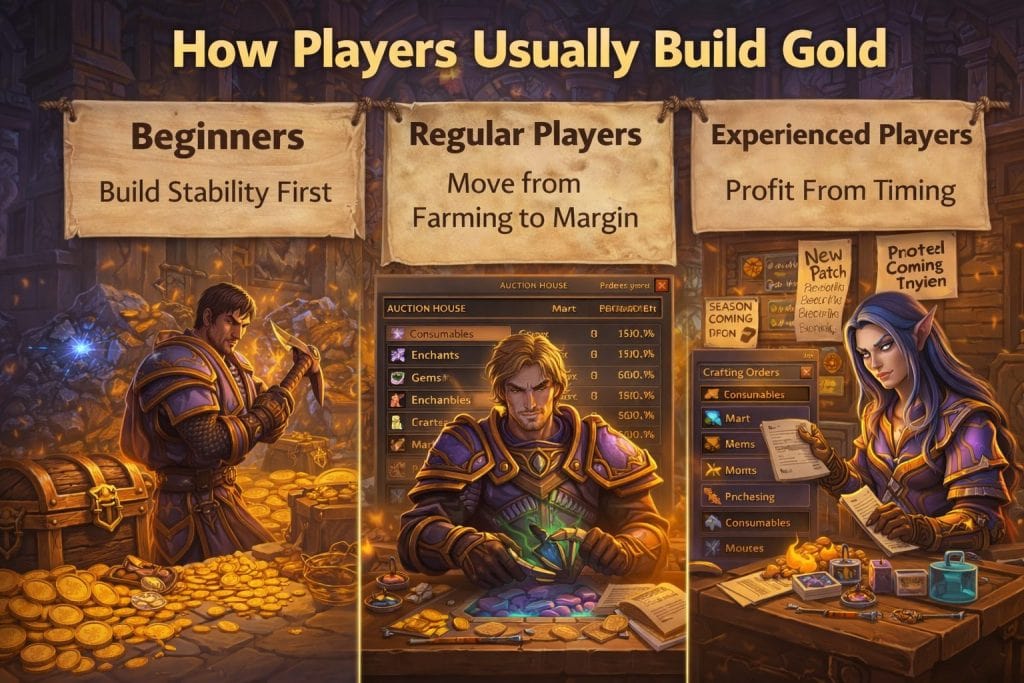
Beginners build stability first
For newer players, the best goal is not to chase the biggest profit. It is to create a repeatable source of income that covers weekly needs without stress. Gathering professions still work well for that because they convert ordinary playtime into items that other players want to buy. This helps cover repairs, consumables, enchants, and smaller progression costs while building the first usable amount of capital.
At this stage, simplicity is a strength. If a method is easy to repeat and does not depend on perfect timing, it is often more useful than a more advanced strategy that breaks down after one bad market cycle.
Regular players move from farming to margin
Once a player has a stable gold cushion, the next step is usually professions or targeted Auction House activity. This is where the economy starts rewarding judgment rather than just time spent. Players who can turn materials into finished goods, understand when demand is rising, and avoid weak margins usually make more than players who only farm raw materials.
Retail supports this because endgame players constantly need usable output. Crafted items, consumables, enchants, and similar purchases remain relevant as long as players continue gearing, replacing pieces, updating builds, and preparing for group content. The stronger the seasonal push, the stronger the convenience market around those needs.
Experienced players profit from timing
The highest-end gold making in WoW Midnight usually comes from timing rather than grind. This includes buying materials before demand rises, selling when players are under pressure to prepare, and understanding which parts of the economy become more active around resets, patches, and seasonal changes.
This is where flipping, stockpiling, and patch preparation become useful. These methods are not as stable as gathering, but they offer much stronger upside for players who know how the market behaves. In Retail, buyers often pay for speed, readiness, and convenience. That is exactly where experienced players make their margin.
Why Professions Matter More Than Before
Professions carry much more weight in modern Retail because Blizzard tied them directly to progression instead of leaving them as background side content. Systems like Crafting Orders allow players to request specific items from crafters, while recrafting helps keep crafted gear useful for longer by improving or adjusting an item instead of replacing the whole process from the start. Blizzard also explains this shift in its official World of Warcraft professions overview.
That changes how players should think about making gold. A profession does not become valuable just because it is leveled. The real value comes from knowing where it fits in the wider economy. Some players supply raw materials, some turn those materials into finished products, and others focus on higher-value crafted gear or repeat demand through recrafting. The better you understand your role in that chain, the easier it becomes to turn a profession into a steady and dependable source of income.
The Biggest Mistakes That Kill Profit
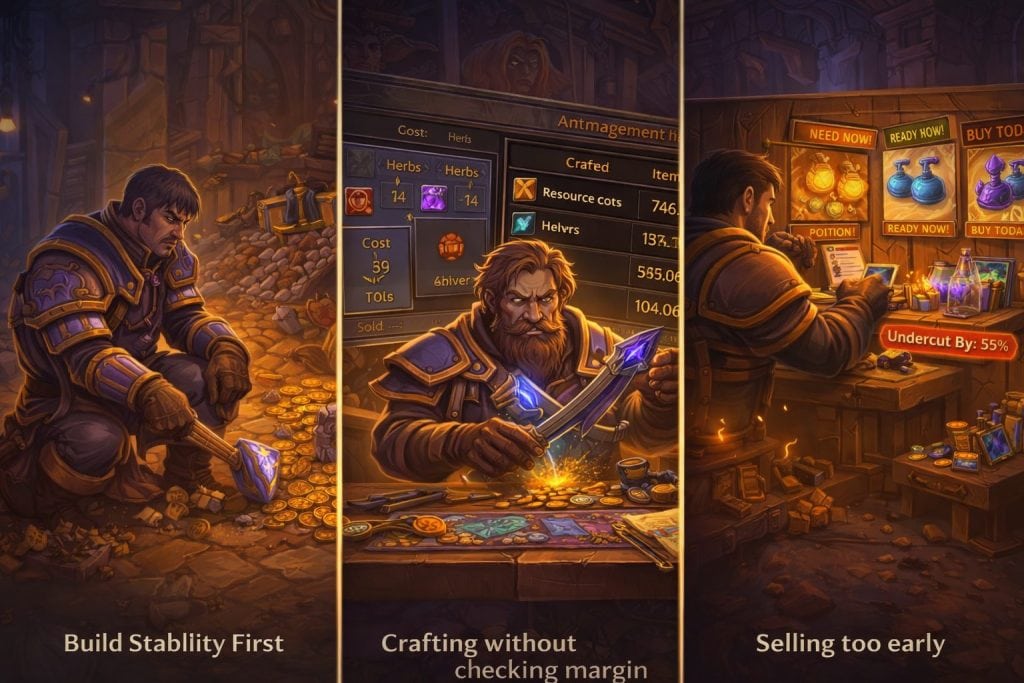
Farming without a clear goal
A lot of players spend hours doing content that feels productive but produces weak returns. They gather random materials, kill mobs in average spots, or fill their bags with items that do not convert into meaningful profit. Time in WoW always has value, and vague farming often wastes that value.
Crafting without checking margin
Crafting can look profitable on the surface because the sale price appears high. That is misleading. Real profit depends on material cost, competition, current demand, and how aggressively the market is being undercut. A strong recipe one day can become a weak choice the next.
Selling too early
Many players post materials or crafted goods immediately because it feels efficient. In practice, that can leave a lot of gold on the table. Retail demand moves in waves. Reset cycles, raid preparation, Mythic+ pushes, and seasonal content all change buying behavior. Players who understand timing often make more than players who simply sell first.
Ignoring convenience demand
One of the most useful truths in the WoW Midnight economy is that buyers are often paying to skip friction. They are not rewarding your effort. They are paying to save their own time. The clearer you are about where players feel pressure, the easier it becomes to understand why certain items keep selling.
How Gold Supports Endgame Progress
Gold matters in Retail because it protects your momentum. It helps keep your character ready for raid nights, supports Mythic+ preparation, funds crafted upgrades, and makes it easier to maintain multiple specs or alts. For players who want to stay focused on progression instead of spending extra time catching up manually, Manaforge Omega Raid Boost fits naturally into that same logic. Seasonal systems increase that pressure because players are always reacting to current goals, current rewards, and current progression pacing.
This is the point many players miss. Gold is not important because being rich looks impressive. Gold is important because being underfunded creates drag across the entire week. Every repair, every enchant, every consumable purchase, and every crafted upgrade feels heavier when your reserves are weak. In a game built around repeat preparation, gold supports freedom.
Best Gold-Making Paths in WoW Retail
| Player type | Best approach | Why it works | Risk level | Time demand |
|---|---|---|---|---|
| Beginner | Gathering, simple raw farming | Easy to start, steady sales, low setup | Low | Medium |
| Regular player | Profession output, consumables, crafted items | Better margins, repeat demand, stronger scaling | Medium | Medium |
| Experienced player | Auction House timing, stockpiling, flipping | Highest upside, profit from knowledge instead of pure grind | High | Medium to high |
A Practical Weekly Gold Strategy
A strong Retail gold routine works best when it stays practical and easy to repeat. Most players get better results from a simple system they can maintain every week than from a complicated setup they abandon after a few days.
Start with one reliable income source that matches your schedule. Gathering, targeted farming, and other low-risk methods are useful here because they help cover baseline expenses without adding pressure. The first goal is stability, not maximum profit.
After that, add one source of income that can scale over time. This is often a profession niche, a crafted item with steady demand, or a market pattern you already know how to read. For players who prefer to spend less time catching up and more time staying close to current content, WoW Level Boost can fit into that same progression-focused approach.
It also helps to check demand before making any move. An item that looked profitable last week may be much weaker now. The Retail economy shifts with resets, seasonal goals, and player urgency, so timing still matters even with a simple strategy.
Most importantly, your own character comes first. Gold making is useful when it supports progress, not when it slows everything down. Keep your enchants, consumables, crafted upgrades, and other core needs covered before treating the economy like a separate project.
Used well, this WoW Retail economy guide helps players turn gold into smoother weekly progress instead of extra grind.