
Abyss Warlock is one of the cleaner early-to-Hell paths in Diablo 2 Resurrected right now. With Season 14 now live on Blizzard, it comes online early, clears packs without awkward setup, and keeps enough range and control to stay comfortable through Normal, Nightmare, and most of Hell. That makes it a strong choice for players who want a dark-caster setup that feels active from the first acts instead of only becoming good once expensive gear shows up.

This guide keeps the focus on practical play. You will not find a bloated theory dump here. The goal is to show how Abyss Warlock moves through the campaign, what to use at each stage, which early items matter, and where to spend time when the campaign starts pushing back.
Why Abyss Warlock is a strong early choice
A lot of early-game setups only feel good once several pieces come together. Abyss Warlock is different. It gets a reliable early spell, upgrades into a better clearing pattern soon after, and keeps enough control to stay safe in crowded zones. You are not trying to force an endgame setup too early. You are building toward one while still having a setup that works in the campaign.
The core appeal is simple. Miasma Bolt gets you moving. Miasma Chain becomes the main tool once it unlocks. Abyss helps on tougher enemies and bosses later. You also get enough flexibility to deal with awkward fights instead of watching the build fall apart the moment a pack resists your main damage type.
Recommended Services


The basic campaign path
The early path is straightforward. You begin with Miasma Bolt, then shift into Miasma Chain once it becomes available. After that, the build starts to feel far more natural because your damage spreads better through packs and rewards cleaner positioning.
Early game plan
In the opening acts, your job is not to kill every monster one by one. Focus on dense packs, quest progress, and the pieces that matter for the next jump in power. Rings, amulets, charms, chipped gems, and simple socketed bases are worth more than a lot of random clutter that only slows you down.
Miasma Bolt carries the first part of the campaign without much drama. Once Miasma Chain enters the setup, the character starts feeling more complete instead of temporary.
Mid-game shift
Nightmare is where the setup settles. By then, you are not just surviving. You are starting to move with purpose, picking better fights, leaning on cleaner area damage, and caring more about cast rhythm, resistances, and positioning than about raw luck.
This is also where small gear improvements start paying off harder. A modest upgrade to movement, mana comfort, or survivability can save more time than a flashy item that does not solve the real problem.
Hell progression
Hell is where weak early plans usually get exposed. Abyss Warlock still holds up here because it does not rely on a single narrow trick. You have crowd damage, a safer range than many melee styles, and enough room to work around dangerous fights instead of taking every hit head-on.
That does not mean Hell is free. Resistances matter. Your item bases matter. Your positioning matters even more. But the character stays playable without turning into a slow rescue mission.
Skill progression that keeps the setup smooth
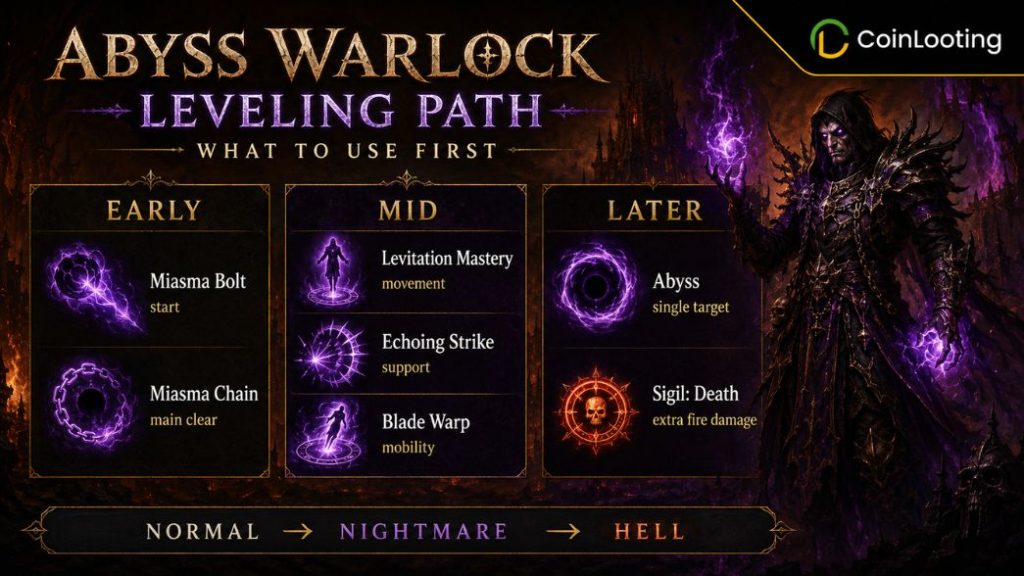
The easiest way to level Abyss Warlock is to keep the setup simple and let each new point solve an actual need.
Levels 2 to 11
Use Miasma Bolt as the main button. It is enough for early progress and does not ask for special gear before it starts doing its job.
Levels 12 to 15
Move into Miasma Chain and let it take over most fights. This is the point where the setup starts clearing more naturally, especially when enemies group up or move through the same lane.
Level 16 to 18
Add Levitation Mastery, Echoing Strike, and Blade Warp as they open. These do not replace the main plan, but they round it out and make movement and pacing feel better.
Later campaign levels
Once tougher elites and bosses begin taking longer, bring Abyss into the setup for stronger single-target pressure. A few points in Sigil: Death also help when the character needs extra fire damage to smooth out ugly fights.
Recommended Services
How the setup actually plays
Abyss Warlock plays best when you treat it like a moving caster, not a stationary turret. Cast, reposition, pull enemies into damage, then keep moving. If you stop too long in bad terrain or let ranged monsters pin you down, the setup feels worse than it really is.
What to do in normal fights
Against standard packs, Miasma Chain does the heavy lifting. The best results come when several enemies pass through the same damage area instead of being pulled into separate directions. That is why clean movement matters so much. Good pathing makes the setup look much stronger than it would on paper.
What to do against elites and bosses
This is where Abyss starts mattering more. Use your main clearing pattern to control the area, then drop stronger pressure on priority targets. Bosses are less about panic and more about patience. Keep your damage running, respect the arena, and do not turn every fight into a face-tank attempt.
What slows the build down most
The biggest mistakes are simple. Fighting too many single monsters, looting too much junk, ignoring item bases, entering Nightmare or Hell underprepared, and pretending resistances can wait until later.
That last one is where many smooth runs start to wobble.
Attribute points without wasting them
Early progress stays cleaner when most points go into what keeps you alive and lets you equip your next useful base.
A safe allocation pattern
| Stage | Main Priority | Why It Works |
|---|---|---|
| Early levels | Vitality | Gives breathing room before gear fills the gaps. |
| When a base requires it | Dexterity or Strength | Only add what you actually need to equip gear. |
| Most of the campaign | Vitality again | Helps the build stay stable instead of fragile. |
That is the real rule here. Do not over-invest into stats too early just because a future item may want them.
The early items that matter most
This kind of guide gets better the moment it stops pretending every slot needs something special. Most of the time, a few smart basics matter more than ten dream pieces.
Stealth
A simple Tal + Eth body armor still does real work. Faster movement, cast speed, and hit recovery are exactly the kind of early quality-of-life gains that make a caster setup feel less clumsy.
Lore
Ort + Sol in a proper helm stays one of the cleanest early skill upgrades. It does not ask for much and continues pulling its weight longer than many players expect.
Spirit later on
If you move into a caster setup that wants more skills, mana, and cast rhythm, Spirit is still one of the most natural upgrades to aim for. It is the kind of mid-game jump that keeps the campaign smooth without turning the whole run into a hunt for luxury gear.
What to keep while leveling
Keep chipped gems, runes from Countess runs, useful charms, rings, amulets, and clean socketed bases. Do not fill your inventory with gear that looks fancy but does nothing for the build.
Countess runs and why they matter here
Abyss Warlock does not need a huge shopping list to get going, but Countess farming still helps because it gives you a realistic path into the cheap crafts that smooth out the campaign.
In practice, those runs are less about chasing something glamorous and more about making sure your next step is ready instead of delayed by one missing rune. That matters more than people think during a fresh start.
If your plan later includes Heart of the Oak or other caster upgrades, it also makes sense to keep an eye on runes that will matter once the early phase is over, like Gul Rune, Vex Rune, Ohm Rune, and Ist Rune.
Recommended Services
What to watch before Nightmare and Hell
Abyss Warlock can push forward aggressively, but that does not mean each difficulty jump should be rushed mindlessly.
Before Nightmare
Try to enter with a setup that already feels stable, not half-finished. That usually means your main spell pattern is set, your movement is comfortable, and your resistances are not being ignored.
Before Hell
Hell punishes sloppy gearing much harder. If your Cold, Fire, and Lightning resistances are lagging, or your life pool feels thin, farming a little longer is usually smarter than trying to brute-force the next act.
For many characters, a few extra levels and cleaner charms solve more than another random weapon swap ever will.
A simple checklist for the run
What to pick up early
- Chipped Gems for useful cube utility
- Rings, amulets, and charms that can improve comfort quickly
- Socketed helms and body armor for early crafts
- Countess runes that help build Stealth, Lore, and later upgrades
What to avoid
- Over-looting junk rares that only slow the run down
- Forcing endgame gear ideas too early
- Ignoring resistances before a difficulty jump
- Using magic bases for rune combinations that need plain socketed ones
When the build starts feeling complete
Abyss Warlock usually feels good long before the campaign ends, but it starts feeling complete once a few things line up at the same time: cleaner cast flow, decent resistances, enough life to stay calm in dangerous pulls, and at least one or two crafted pieces that stop the run from feeling improvised.
That is also where the next stage begins. Once leveling is mostly under control, you start thinking less about survival and more about what version of the class you actually want to finish with.
If that later plan includes more expensive caster pieces or transition runes, Mal Rune can also become relevant depending on what you want to build next.
FAQ
Why this path works for so many players
Abyss Warlock works because it does not ask you to fake progress with a bad endgame setup. It gives you a clean early spell, a natural upgrade path, useful farming stops, and enough control to keep the campaign moving without constant frustration.
That makes it one of the more comfortable dark-caster options in Diablo 2 Resurrected Season 14, especially for players who want something active, practical, and strong before the late-game gear chase fully begins.