
Path of Exile 2 endgame changes hard after the campaign. In Return of the Ancients, the Atlas is no longer just a loose chain of maps. It is rebuilt around Towers, Waystones, the Fortress, mechanic questlines, Masters, Atlas Passive Tree choices, and boss routes.
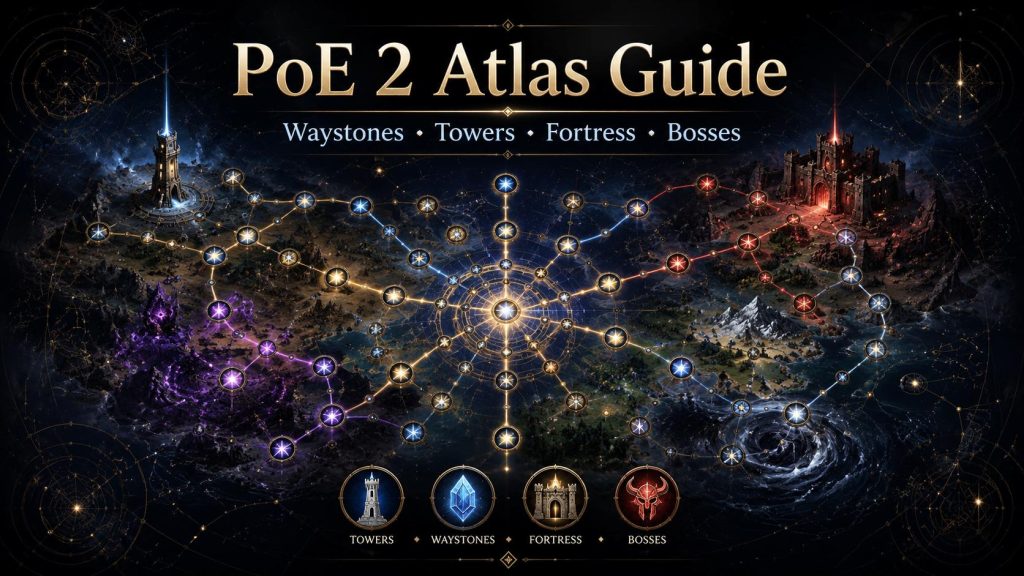
This PoE 2 Atlas guide is written for players who have finished the campaign and want a clear first route through 0.5.0 endgame. It explains how to read the new Atlas, how Waystones now work, why the Fortress matters, how Masters fit into mapping, how mechanic questlines differ, and when bosses belong in your route.
Recommended Services



Quick Answer
Your first Atlas goal in PoE 2 should be simple: activate your early Towers, follow the new endgame questlines, protect your Waystone supply, use Masters before maps when they match your plan, and move toward the Fortress without forcing boss routes before your build is ready.
The best early route is:
- Finish the campaign.
- Enter the Atlas and start with lower-tier Waystones.
- Use Towers to reveal nearby areas.
- Follow The Origins of Divinity toward the Fortress.
- Spend Atlas points with one goal.
- Pick one mechanic path first.
- Use Masters before opening maps when they improve that run.
- Push bosses through questlines after your build feels ready.
What Changed in the 0.5.0 Atlas
Grinding Gear Games confirms in the official Return of the Ancients FAQ that Standard Early Access Atlas progress resets with the update. The Atlas Passive Tree resets too. Players begin the new endgame storylines from the start. The same FAQ confirms that Temple of Atziri and its mechanics become part of Path of Exile 2’s core game in Return of the Ancients.
For players, the bigger change is how the Atlas now feels after campaign. Competitor coverage from Mobalytics and other reveal summaries describes a more structured endgame. The Atlas has clearer points of interest, mechanic questlines, a large Fortress route, reworked Atlas Passive Trees, three Atlas Masters, and new Pinnacle Boss paths.
The main 0.5.0 Atlas changes are:
| System | Before 0.5.0 | In Return of the Ancients |
|---|---|---|
| Atlas shape | Mostly open map movement around Towers | Fixed directions, mechanic regions, Fortress routes, and open wilderness |
| Atlas Passive Tree | Smaller impact on map planning | Reworked tree with deeper route and reward choices |
| Mechanic trees | Limited mechanic investment | Major mechanics get their own deeper Atlas planning |
| Masters | Not part of the system | Three Masters: Jado, Hilda, and Doryani |
| Boss access | First attempts could feel tied to random access | First boss routes are more quest-driven |
| Waystone flow | Tier movement could feel inconsistent | Bosses matter more for moving into higher tiers |
| Temple of Atziri | Seasonal Fate of the Vaal content | Core game content in Return of the Ancients |
This is why a generic mapping guide is not enough for 0.5.0. The new Atlas asks you to read routes, use Towers, enter Fortress areas, follow mechanic questlines, and choose Masters with intent.
Before You Start Mapping
The official FAQ confirms that Runes of Aldur starts with a fresh economy. It also confirms that older Standard Early Access characters remain playable, but their Atlas progress resets. If you want to play the Runes of Aldur league, you need a new character under that league banner.
This guide focuses on the Atlas after the campaign. It does not replace a league-start build guide. Patch notes, balance changes, skill tuning, and final reward values can still change the best farming choices. Use this as a route guide, then adjust once live patch data and real economy prices settle.
The 0.5.0 Build Planner is useful before you enter maps. If you follow a creator build, check whether the planner covers early defenses, not just damage. Atlas progress becomes much smoother when your build has a clear path for resistances, recovery, movement, and single-target damage.
The Core Atlas Loop After 0.5.0
The Atlas loop now has more structure than before. You are not just opening maps until something valuable appears. You are moving through revealed areas, using Towers, following storylines, opening Waystones, earning passive progress, and preparing for larger boss routes.
The basic loop looks like this:
- Enter the Atlas after campaign completion.
- Use Waystones to open maps.
- Use Towers to reveal nearby areas.
- Follow visible questline routes.
- Move toward Fortress areas when they appear.
- Earn Atlas Passive Tree progress through endgame objectives.
- Choose Masters before opening maps when their modifiers fit your goal.
- Push harder bosses after your build proves itself in the current tier.
This is the biggest mindset change. The Atlas now gives more direction. That makes planning more valuable. In older mapping, the mistake was chasing every shiny node. In 0.5.0, the mistake is splitting your route and Atlas points across too many systems before one path starts paying off.
Towers and Precursor Tablets
Towers remain one of the main tools for reading the Atlas. Their job is to reveal nearby areas and help you see what is worth running next. If you skip Towers, you lose route clarity. That can make your Atlas feel random even when the new system is built around clearer goals.
Precursor Tablets add another layer. They can apply extra content or modifiers to nearby maps, which makes Towers part of your farming plan rather than simple map reveal points.
How to Use Towers Early
- Clear early Towers to reveal more route options.
- Run Towers near the edge of your stable region. That reveals new space without forcing a risky jump.
- Look for Fortress movement after your first Tower progression.
- Use Tablets only when the surrounding maps are worth modifying.
- Do not add extra pressure to maps your build already struggles with.
- Treat Towers as route planning tools, not side stops.
A strong Tower plan saves Waystones. You see more of the Atlas, choose better nearby nodes, and avoid burning maps on blind movement.
The Fortress and The Origins of Divinity
The Fortress is one of the biggest reasons this Atlas guide needs a 0.5.0 rewrite. Reveal coverage describes it as a major new endgame structure tied to The Origins of Divinity. It appears as part of the new Atlas route and creates a clearer spine for post-campaign progress.
Inside Fortress regions, maps can have special mechanics. Reveal summaries mention examples such as essence-crystal rare packs, strongbox-focused areas, and Azmeri spirit hunts. These are not just random extras. They are part of the new push toward a more structured Atlas.
The Fortress matters because it connects several endgame goals:
- Atlas route direction
- new story progress
- Atlas Passive Tree points
- boss movement
- Fortress-specific map pressure
- longer-term endgame goals
How to Approach the Fortress
Do not treat the Fortress as optional flavor. If it appears on your Atlas route, it deserves attention. At the same time, do not enter Fortress maps blindly. These areas can carry special rules and extra pressure.
Before pushing deeper, check:
- current Waystone tier
- map modifiers
- resistances and recovery
- single-target damage
- movement comfort
- whether your Master choice fits the map
The Fortress gives the Atlas a clearer center. It also raises the cost of careless mapping. If your build is not ready, farm around it first, upgrade, then return with better control.
Waystones Explained: Tiers, Boss Drops, Failed Maps

Waystones open Atlas maps. They come in tiers, and higher tiers mean higher-level monsters. PoE2DB lists Waystones from Tier 1 upward, with higher tiers tied to higher area levels. It also notes that Waystones can be modified to increase difficulty and rewards.
That part is familiar. The new Atlas route makes Waystone management more important.
What Waystones Control
| Waystone Part | What It Changes | Why It Matters |
|---|---|---|
| Tier | Base map level | Higher tiers punish weak builds faster. |
| Modifiers | Danger and reward rules | Some modifiers directly counter builds. |
| Rarity | Reward pressure and modifier count | More value can mean more risk. |
| Map boss value | Tier movement and loot potential | Bosses can support Waystone progression. |
| Remaining supply | How many attempts you can afford | Low supply forces weaker routes. |
| Boss readiness | Whether the map boss is realistic | Tier movement can depend on boss kills. |
PoE2DB notes that powerful map bosses can drop Waystones one tier higher. It also notes that only the final powerful map boss in a map area has a chance to drop a Waystone above that area’s tier. This makes bosses part of Waystone progression, not just loot targets. Skipping bosses can slow your tier climb, even when map clear feels fast.
Practical Tier Thinking
Use tiers as pressure bands:
- T1-T5: learn map flow, build supply, fix early gear.
- T6-T10: test whether your build handles stronger modifiers.
- T11-T15: push harder farming routes, bosses, and specialized mechanics.
- T16 and above access rules: check exact requirements before committing valuable runs.
Do not jump tiers just because a stronger Waystone drops. A steady T7 route can be better than a failed T10. The map you finish is usually better than the map you lose.
Smart Waystone Habits
- Read every modifier before entry.
- Keep lower-risk Waystones for recovery.
- Use bosses to climb tiers when your build is ready.
- Avoid hard modifiers during build testing.
- Do not spend your best Waystones on unclear goals.
- Check whether a Tablet or Master modifier makes the run too dangerous.
Atlas Passive Tree and Mechanic Trees
The Atlas Passive Tree has been rebuilt for Return of the Ancients. Mobalytics reports that the new tree has over 200 points, and all of them can be allocated. Reveal coverage also describes many nodes as more meaningful, with choices that can change reward and difficulty.
This changes how you spend points. The Atlas tree is no longer just a small bonus layer. It is a real endgame build for your maps.
Main Atlas Tree vs Mechanic Trees
There are two layers to think about:
| Tree Type | What It Does | Early Advice |
|---|---|---|
| Main Atlas Passive Tree | Shapes broad map progress, rewards, and difficulty. | Start with sustain and route stability. |
| Mechanic Trees | Improve Breach, Delirium, Expedition, Ritual, Abyss, and related systems. | Pick one mechanic first. |
| Master Trees | Add map modifiers and special bonuses through Atlas Masters. | Choose per map goal. |
The mistake is trying to scale every layer at once. If you invest into several mechanics before your build is ready, the Atlas becomes noisy. Rewards go up on paper, but failed maps can erase the gain.
Early Atlas Point Plan
- Start with route stability. Keep maps available and manageable.
- Pick one mechanic tree. Learn its pressure before deeper investment.
- Add reward scaling after clean clears. Do not scale danger first.
- Use Master choices per map. Match them to the run you are opening.
- Move toward boss points when your current tier feels controlled.
A strong Atlas tree has a purpose. It should answer a simple question: what am I trying to farm, and can my build finish that content reliably?
Recommended Services
Masters of the Atlas: Jado, Hilda, Doryani
Masters are not a late extra. In 0.5.0, they are part of how you shape maps. Reveal coverage and the official Return of the Ancients materials present three Atlas Masters: Jado, Hilda, and Doryani.
Mobalytics reports that these Masters can be switched freely on a per-zone basis before opening an area in the map device. That changes the advice completely. You should not wait until your Atlas feels perfect. You should learn what each Master does and choose the one that fits the map you are about to run.
How Masters Fit Into Mapping
| Master | General Role | When to Consider It |
|---|---|---|
| Jado | Artifact and reward-focused direction | When you want reward discovery and map value |
| Hilda | Monster-hunt direction | When your build handles dangerous enemies well |
| Doryani | Precursor and Atlas-system direction | When your route leans into deeper Atlas mechanics |
Exact values and final tuning can change. The practical rule stays the same: choose the Master before the map based on what that run is trying to do.
Better Master Habits
- Check the map first, then choose the Master.
- Do not add boss pressure to a weak bossing build.
- Use reward-focused choices when the map is already safe.
- Change Masters between zones when the next run has a different goal.
- Treat Master choices like part of your map setup, not a permanent identity.
Bosses and Questline Progression
Boss access in 0.5.0 is more guided. Mobalytics reports that every existing mechanic gets a questline, and new Pinnacle Bosses are tied to the updated endgame structure. This means first boss access is less about waiting for random luck and more about following the correct route.
That does not mean you should rush every boss. Quest access and build readiness are different things. A questline can point you toward a boss before your gear is ready for a clean kill.
Known Questline Directions
| Route | What It Points Toward | Early Advice |
|---|---|---|
| The Origins of Divinity | Fortress and core Atlas progress | Treat as a main route |
| Breach route | Keepers of the Flame and Hiveborn progress | Bring clear speed and control |
| Delirium route | Raven Trickster / Tangmazu direction | Watch scaling pressure |
| Ritual route | Aoife and King in the Mists direction | Prepare for chained fights |
| Expedition route | Gwennen, islands, Logbook progress, later boss access | Read modifiers carefully |
| Abyss route | Abyssal Depths and deeper faction progress | Bring movement and recovery |
Boss Readiness Checklist
- Your current map tier feels comfortable.
- You are not dying to normal rare monsters.
- Your resistances are stable.
- Recovery works during pressure.
- Your damage is not dragging every fight too long.
- Your Master choice does not make the boss harder by mistake.
- Your Waystone supply can survive a failed attempt.
Bosses are no longer only distant random targets. They are part of the new route. Still, timing matters. Follow the questline, but do not ignore your build’s limits.
League Mechanics in the New Atlas
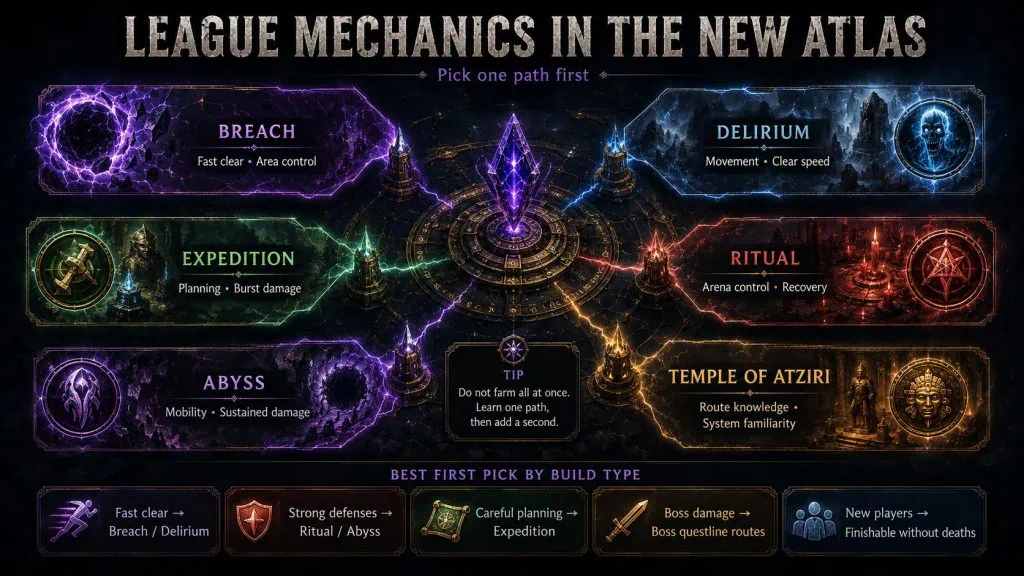
League mechanics are much more than small map events in 0.5.0. They are route choices, questline paths, boss access paths, and passive investment targets.
Here is the cleaner way to think about them:
| Mechanic | 0.5.0 Direction | What Your Build Needs |
|---|---|---|
| Breach | Unstable Breach encounters, Hiveborn progress, Genesis Tree, later Breach boss route | fast clear, area control, strong recovery |
| Delirium | visible pressure tracking, deeper madness route, Tangmazu direction | movement, clear speed, panic control |
| Expedition | island-style progression, Gwennen route, Logbook movement, later Pinnacle path | careful reading, burst damage, modifier discipline |
| Ritual | chained map choices, captured monsters, Aoife route, King in the Mists direction | arena control, defenses, recovery under waves |
| Abyss | larger connected Abysses, Abyssal Depths, faction progress | mobility, sustained damage, flexible positioning |
| Temple of Atziri | core Vaal content from Return of the Ancients | route knowledge and system familiarity |
Do not farm all of them at once. Pick one mechanic path first. Learn its pressure, rewards, boss route, and passive tree. Then add a second path after your map sustain feels safe.
Best First Mechanic by Build Type
| Build Strength | Better Early Mechanic Choice |
|---|---|
| Fast clear | Breach or Delirium |
| Strong defenses | Ritual or Abyss |
| Careful planning | Expedition |
| Boss damage | Routes that lead into boss questlines |
| New player comfort | The mechanic you can finish without deaths |
A mechanic is only profitable if you can complete it. Failed mechanics waste Waystones, time, and reward scaling.
First Endgame Route After Campaign
This is the route I would use for a new endgame character in Return of the Ancients.
- Finish campaign and check your build. Fix obvious gaps before Atlas.
- Start with low-tier Waystones. Use T1-T5 to learn pressure and rebuild gear.
- Clear Towers early. Reveal nearby areas before committing to a long direction.
- Follow The Origins of Divinity. Move toward the Fortress route when it opens.
- Run maps you can finish cleanly. Clean clears beat lucky high-tier attempts.
- Choose a Master before opening the map. Match Jado, Hilda, or Doryani to the run.
- Pick one league mechanic path. Do not split early passives across every system.
- Use bosses to climb when ready. Higher-tier Waystones from powerful bosses matter more now.
- Upgrade before T11+ pressure. Do not drag weak gear into punishing maps.
- Push Fortress and Pinnacle routes once normal mapping feels stable.
This route gives the article a real player path, not just a system list. It also matches how the new Atlas is being presented: fixed objectives, Towers, Fortress movement, questlines, Masters, and boss progression.
Recovery Plan After Failed Maps
Failed maps are part of Atlas learning. Repeating the same failure is the real problem.
Death in Atlas maps can cost XP and map attempts. Depending on the map setup, it can also consume the Waystone run and remove the value attached to that attempt. This is why “just try harder content” is bad advice for early mapping.
After several failed maps, check the cause:
| Problem | What to Change |
|---|---|
| Tier too high | Drop down and rebuild supply |
| Bad modifiers | Filter Waystones more carefully |
| Weak damage | Upgrade weapon, gems, supports, or scaling stats |
| Weak survival | Fix resistances, life, energy shield, armour, evasion, recovery, or movement |
| Wrong Master choice | Pick a safer Master for the next run |
| Mechanic too hard | Pause that mechanic path |
| Boss too early | Farm maps and return later |
A failed map should teach you something. If it does not, you will burn the next Waystone the same way.
Recommended Services
Currency, Gear, and Atlas Progress
Atlas progress often slows down when gear falls behind. A player can read routes correctly and still fail maps if weapon damage, resistances, recovery, movement speed, or key build items are weak.
Currency matters most at three points:
- before raising Waystone tiers
- before Fortress pressure
- before boss questlines
If failed maps come from weak gear rather than route mistakes, PoE2 Currency from CoinLooting can support crafting and trade preparation before harder Atlas content. Players working on rerolls and early upgrades can use PoE 2 Chaos Orbs when one gear slot blocks the next tier.
Keep the decision practical. Fix the slot that stops progress first. That is usually weapon damage, resistances, movement speed, recovery, or the item that makes the build work.
Common Atlas Mistakes in 0.5.0
Skipping Map Bosses
In 0.5.0, boss kills matter for tier movement. A pure clear-speed route that avoids bosses can slow your Waystone climb.
Ignoring Towers
Towers reveal nearby areas and improve route planning. Skipping them makes the Atlas feel more random than it is.
Treating the Fortress Like Side Content
The Fortress is tied to the new core endgame route. If it appears in your progression path, plan around it.
Opening Waystones Without Reading Modifiers
A bad modifier can be harder than a higher tier. Check the map before entry.
Choosing Masters Too Late
Masters are part of map setup. Pick one before opening the area, then change when the next run needs something different.
Spreading Atlas Points Across Too Many Systems
The Atlas has more options now. That makes focus more valuable, not less.
Farming Every Mechanic at Once
Each mechanic has its own route and pressure pattern. Learn one path first.
Rushing Bosses Just Because the Quest Appears
A questline can show the boss before your build is ready. Follow the route, but respect the gear check.
Forgetting the Build Planner
The Build Planner can expose weak gear, missing passive steps, and unclear upgrade goals before they cost you maps.