
Path of Exile can feel heavy during the first hours. The passive tree is huge, items have many modifiers, skill gems change how your character plays, and the campaign gives only part of the explanation. New players often lose time in the same places: weak resistances, random skill choices, poor flask setup, unclear gear priorities, and no plan after Act 10.

This Path of Exile beginner guide gives you a clean starting route. You will learn how classes work, why builds matter more than class fantasy, how to level through the campaign, what currency is used for, when trading becomes useful, and what to do when maps open after the story.
Grinding Gear Games describes Path of Exile: Mirage as the 3.28.0 challenge league with Standard, Hardcore, and Solo Self-Found versions, 40 league challenges, Djinn encounters, and reward progression tied to challenge completion. That makes build planning, currency use, and early mapping decisions especially relevant for new players entering the current league cycle.
A beginner-focused look at Path of Exile, from first character setup to early mapping, trading, gear upgrades, and endgame direction.
Quick Answer
The easiest way to start Path of Exile is to choose a beginner-friendly league starter build, follow the campaign without changing skills too often, keep elemental resistances high, upgrade flasks regularly, and treat the first character as a learning character. Do not try to understand every mechanic at once. Learn the campaign, your main skill, your defenses, basic currency, and early maps first.
Recommended Services


For most new players, the best early plan is:
- Pick a proven starter build with clear leveling notes
- Use one main damage skill and support it properly
- Keep life, resistances, and movement speed on gear
- Upgrade weapons when attack damage starts falling
- Save valuable currency until you know its trade value
- Enter maps after Act 10 and progress one tier at a time
What Path of Exile Is Like for New Players
Path of Exile is an action RPG built around character builds, loot, trading, crafting, and endgame mapping. The campaign teaches movement, combat, gems, bosses, and item basics, but the long-term game opens through maps, Atlas progression, league mechanics, crafting, and boss routes.
The first beginner mistake is treating the class name as the full build. A Witch is not always a summoner. A Ranger is not always a bow character. A Marauder is not locked into basic melee. Your class gives you a starting position on the passive tree and access to Ascendancy choices. Your skill gems, support gems, passive tree, gear, and defenses decide how the character actually plays.
That is why beginners usually have a smoother first run with a build guide. A guide gives you the main skill, passive tree direction, gem links, gear priorities, and early mistakes to avoid. You can experiment later, once you know how damage, defenses, flasks, attributes, and trading connect.
Choosing Your First League and Character
League choice matters when you create a character. New challenge leagues have fresh economies, active trading, and league-specific mechanics. Standard keeps long-term characters and accumulated items. Hardcore adds permanent death pressure. Solo Self-Found removes player trading and pushes you toward self-earned gear.
For a first character, a regular challenge league is usually the most practical choice. You get active trade, current mechanics, and more community discussion around builds. Hardcore fits better after you already know boss patterns, damage spikes, gearing basics, and map modifiers.
Beginner-Friendly Build Types
Some build styles are easier for a first playthrough since they reduce pressure during bosses and early maps.
| Build Type | Beginner Value | Main Risk |
|---|---|---|
| Minions | Summoned allies deal damage and distract enemies | Can feel passive if you prefer direct combat |
| Totems | You place damage sources and keep moving | Needs placement rhythm |
| Ranged spells | Good damage from distance and smooth campaign clear | Can feel fragile without defenses |
| Bow builds | Fast clear and strong mapping when geared | Gear can become expensive |
| Tanky melee | Simple combat rhythm and direct hits | Needs steady weapon upgrades |
The safest beginner choice is not always the strongest endgame build. Pick something with clear leveling notes, low gear demand, and simple buttons. A build that reaches maps comfortably is better than a complex build that only works with expensive items.
How to Level Through the Campaign
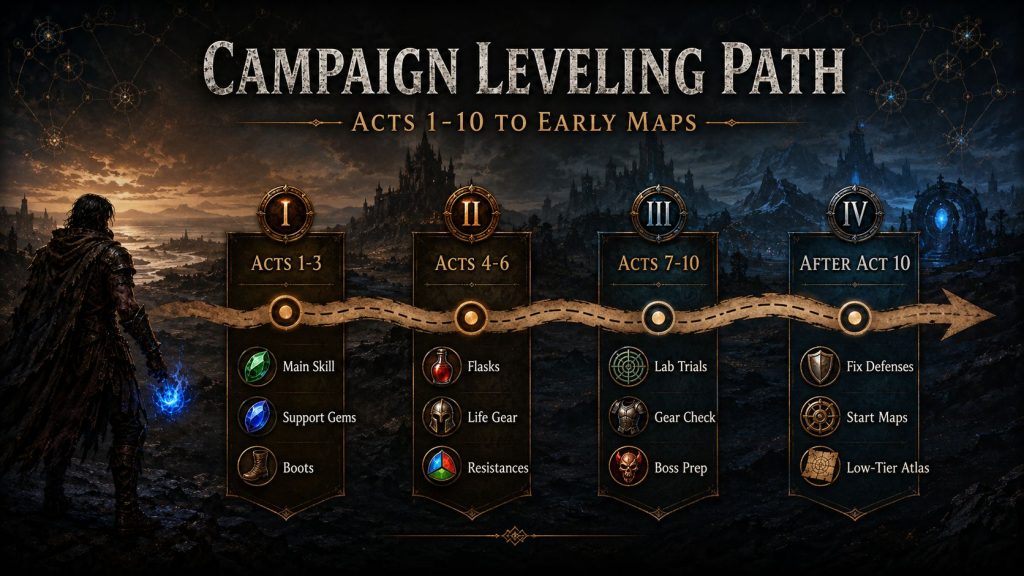
The campaign has ten acts. Your goal is not to full-clear every zone. Move through main objectives, keep gear updated, and avoid wasting time on weak side paths unless they give passive points, skill gems, Labyrinth access, useful rewards, and needed progression.
During the campaign, focus on these basics:
- Keep one main skill as your damage source
- Add support gems that work with that skill
- Put movement speed on boots as soon as possible
- Keep life on most gear slots
- Fix fire, cold, and lightning resistances regularly
- Upgrade flasks as higher-level versions drop
- Use a movement skill for smoother travel
- Complete Labyrinth trials when your build is ready
Resistances become more demanding after campaign penalties. If monsters suddenly hit much harder, check your character sheet before blaming the build. Low elemental resistances make normal packs feel dangerous and bosses feel unfair.
When Damage Starts Falling
If enemies take too long to die, check three things first:
- Your main skill gem level
- Your support gem links
- Your weapon, spell scaling, and relevant damage modifiers
Attack builds usually depend more on weapon upgrades. Spell builds often scale strongly through gem levels, added spell damage, cast speed, and relevant modifiers. New players often wear rare items with many lines of text but no useful stats for the main skill.
Currency, Gear, and Trading Basics
Path of Exile does not use a single gold system like many RPGs. Currency items are crafting materials and trade resources at the same time. Chaos Orbs, Divine Orbs, Exalted Orbs, Orbs of Alchemy, Chromatic Orbs, Jeweller’s Orbs, and Orbs of Fusing all have different roles.
PoE Currency on CoinLooting covers resources used for trade, crafting, modifier rerolls, and gear development across early progress and endgame. For a beginner, the key idea is simple: do not spend rare currency randomly before you know what it is worth.
Early Currency Rules for Beginners
- Use cheaper currency for basic gear fixes
- Save Divine Orbs and high-value drops until you check prices
- Use trade when one missing item blocks your build
- Avoid heavy crafting on low-level gear
- Keep useful resistance, life, and movement pieces while leveling
Chaos Orbs are one of the core trade currencies. Chaos Orbs for Path of Exile can be useful for market purchases, early mapping upgrades, and flexible trade decisions when your build needs a specific item instead of another random drop.
Divine Orbs matter later for stronger gear decisions. They are usually too valuable for random early use, so new players should check trade value before spending them on a campaign item.
Gear Priorities That Matter Early
Beginners often chase damage too hard and forget survival. In Path of Exile, weak defenses can stop progress before low damage does. You need enough life, resistances, flask recovery, movement, and damage to clear without panic.
Early Gear Checklist
- Boots with movement speed
- Helmet, gloves, belt, rings, and amulet with life
- Fire, cold, and lightning resistance across gear
- Weapon stats that match your skill type
- Linked sockets for your main skill setup
- Flask upgrades every few acts
- Utility flasks once enemies start hitting harder
Do not judge an item by rarity alone. A rare item with the wrong modifiers can be worse than a magic item with the exact stat you need. For a first character, clear useful stats beat complicated crafting plans.
Recommended Services
Passive Tree and Skill Gems
The passive tree looks intimidating, but early decisions are simpler than they seem. You are not meant to take random nodes across the whole tree. A build usually follows a path toward damage clusters, life clusters, mastery choices, keystones, jewel sockets, and later specialization.
Skill gems define active abilities. Support gems modify those abilities. A fire spell needs support gems that work with spells, fire damage, casting, projectiles, area damage, burning, and related mechanics. A melee attack needs support gems that work with attacks, weapons, physical damage, strikes, slams, projectiles, and its actual tags.
Read Gem Tags
Gem tags are one of the cleanest beginner tools. If your active skill says Spell, Projectile, Fire, AoE, then supports with matching logic are more likely to work. If a support gem affects attacks, it will not help a spell. If it affects minions, it will not boost your own damage unless the setup is minion-based.
What to Do After Act 10
After Act 10, maps become your main progression system. Maps are endgame zones with modifiers, tiers, bosses, and Atlas progress. This is where many new players realize the campaign was only the first layer.
At this stage, your checklist changes:
- Fix resistances after the final campaign penalty
- Replace weak leveling gear
- Start with low-tier maps
- Complete map bonuses where possible
- Avoid dangerous map modifiers at first
- Pick a few league mechanics instead of chasing every system
- Upgrade flasks and defensive layers
- Learn trade prices before selling valuable drops
Mirage adds a league layer with Djinn-themed encounters, Afarud enemies, astral hazards, and challenge rewards. Keep the first mapping goal simple: stabilize the character before pushing harder modifiers and league encounters.
Common Beginner Mistakes
New players usually do not fail from one bad choice. They fail from several small gaps stacked together.
Changing Builds Too Often
Switching skills every few acts ruins gem levels, passive tree direction, and gear planning. Test skills early, then commit.
Ignoring Resistances
Low elemental resistances make normal content feel much harder. Check them often, especially after campaign penalties.
Spending Valuable Currency Too Early
Do not use expensive currency on random campaign gear. Save it until you know trade value and build needs.
Following Endgame Gear Too Early
Many builds show expensive final items. Check the leveling setup, not just the finished character.
Running Bad Map Mods
Some map modifiers can break your build. Reflect, reduced recovery, no regeneration, reduced aura effect, and heavy damage stacking can be dangerous depending on setup.
Picking Every League Mechanic
Path of Exile has many activities. Learn a few first. Too much at once slows progress and creates confusion.
When CoinLooting Can Fit the Progression Path
A beginner guide should stay useful without turning into a sales pitch. Still, there are real situations where extra currency can reduce repeated farming.
If your build reaches maps but lacks trade items, resistance fixes, six-link progress, flask upgrades, and gear repairs, Path of Exile Currency can support the next step without forcing you back into low-value farming.
For players who already know what upgrade they need, Chaos Orbs can be practical for market purchases and flexible trading. If you reach later mapping and start optimizing stronger items, Exalted Orbs for Path of Exile become more relevant for high-value gear decisions, crafting direction, and endgame trade.
For a deeper farming angle, CoinLooting’s guide on how to make money in Path of Exile covers endgame income ideas through mapping and currency-focused play.