
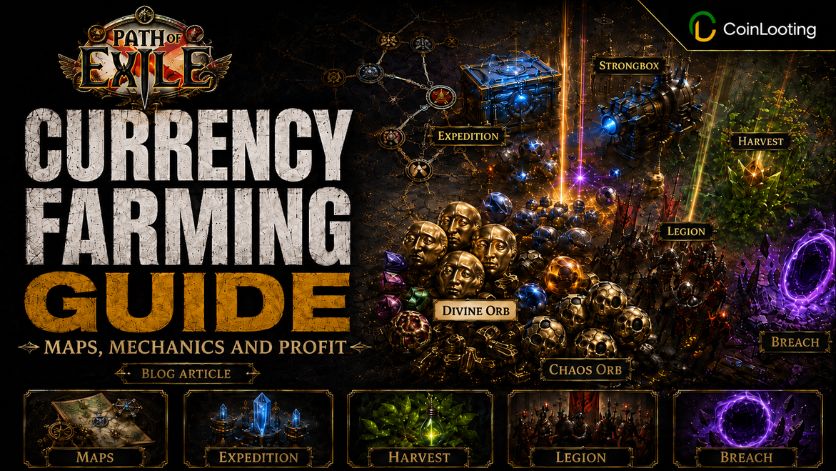
A profitable Path of Exile session is rarely built around waiting for one Divine Orb to hit the ground. Most currency comes from repeating content your character handles efficiently, collecting rewards with steady market demand, and turning those rewards into something you can spend.
This Path of Exile currency farming guide covers that process from early mapping to stronger endgame setups. The focus is not on a temporary Divine-per-hour promise. League prices move, builds clear at different speeds, and farming costs change. A method is useful when it produces consistent value after its expenses are counted.
A strong farming loop usually has four parts:
- Pick content that fits your build
- Keep the cost of each run under control
- Collect rewards that can be sold without excessive downtime
- Reinvest part of the profit into gear and stronger runs
Once those pieces work together, farming becomes much easier to evaluate.
What Counts as Currency Farming in Path of Exile?
PoE does not revolve around one universal coin. Orbs, fragments, Scarabs, crafting materials, league rewards, and many other items can carry trade value.
The PoE Currency hub covers the main currency types used for trading, gear progression, and crafting. CoinLooting currently groups Divine, Chaos, and Exalted Orbs as three separate options with different roles.
This means a profitable Map does not need to drop raw currency directly. Expedition Logbooks, Harvest Lifeforce, Timeless Splinters, Scarabs, Divination Cards, league items, and valuable bases can all become part of the return once they are sold.
For a broader explanation of how PoE wealth and trade interact, the currency creation and trading guide covers the general economy behind accumulating and exchanging currency.
The useful number is not how many currency icons appeared on the ground. It is the total value left after Map costs and other inputs.
What Makes a Farming Method Profitable?
Three variables matter more than a flashy screenshot of one lucky drop: clear speed, investment, and liquidity.
Clear speed decides how many encounters you finish during a session. Investment includes Maps, Scarabs, rerolls, fragments, and anything else spent before the rewards appear. Liquidity describes how easily those rewards can be sold.
A farming method can have high theoretical value and still feel poor if your build dies often, each Map takes too long, or most drops sit unsold in the stash.
This is why copying another player’s setup without checking the character behind it can give disappointing results. A build that clears Legion screens in seconds has different priorities from one that handles Expedition Remnants safely but moves more slowly.
Judge the method by how it performs on your character across a batch of runs, not by its highest possible reward.
Farming Methods Worth Building Around
Several mechanics fit currency farming well because they produce recognizable rewards and can be repeated through Maps.
| Method | Investment | Good fit for | Typical value |
|---|---|---|---|
| General mapping | Low to medium | Most builds | Broad loot, Scarabs, currency, Maps |
| Strongboxes | Low to medium | Fast mappers | Compact encounters and extra rewards |
| Expedition | Low to high | Builds that handle Remnants safely | Logbooks, vendor rewards, currency |
| Harvest | Low to medium | Consistent mapping builds | Crystallised Lifeforce |
| Legion | Medium | Wide clear and strong movement | Splinters, Emblems, dense rewards |
| Breach | Medium | Fast area-clear builds | Breach rewards and Splinters |
| Curse of the Allflame | Variable | Current 3.29 characters | Charts, Voyages, Ducats and league rewards |
This is not a ranking. The method that loses the least time and currency on your character can beat a theoretically richer strategy built for another setup.
General Mapping Gives Every Strategy a Base
Maps connect most endgame farming systems.
A regular Map can carry its own item drops, Atlas mechanics, Scarabs, league encounters, boss rewards, and modifiers that raise the amount of content inside the run.
The key is giving each investment a purpose.
Adding Scarabs at random does not automatically make a Map profitable. If your Atlas setup is built around Expedition, the added investment should strengthen Expedition. If you are farming Strongboxes, the Map setup should support that plan instead.
This keeps the cost readable. You know what you paid for, what was added to the Map, and which rewards are supposed to cover the investment.
Running Maps in batches helps here. Ten similar runs reveal much more than one Map that happened to drop something expensive.
Strongboxes Keep the Loop Close to Normal Mapping
Strongboxes work well for players who prefer short interactions without repeatedly leaving the main Map flow.
You open the box, clear the spawned enemies, collect the rewards, then continue through the Map. A character with strong movement and general clear speed can fit these encounters into normal farming with little interruption.
That simplicity is part of their appeal.
A mechanic does not need a complicated setup to generate useful returns. If the build clears Strongboxes safely and the investment stays reasonable, more completed Maps can compensate for a lower ceiling per individual encounter.
Expedition Rewards Careful Setup
Expedition trades some speed for control.
Remnants change the encounter before the explosions begin. Their bonuses can raise reward value, but their downsides can also interact badly with a build. Reading the Remnants and planning the chain is part of the farming method.
Logbooks add another source of value. A player can run them when the character is suited to the content, then keep the resulting rewards. Selling the Logbook directly is another valid outcome when the market price looks better than the expected personal return.
The mechanic remains relevant in 3.29, though Tujen no longer offers Catalysts after the current league changes.
Expedition is attractive when you prefer fewer, more deliberate encounters instead of relying entirely on raw Map clear speed.
Harvest Turns Crafting Demand Into Tradeable Value
Harvest rewards Crystallised Lifeforce, which ties its value to crafting demand.
That gives the mechanic a different feel from farming random Rare items. Lifeforce is standardized, easier to compare with market prices, and can be accumulated before selling.
The main cost is time.
If your character clears the Grove smoothly, Harvest fits naturally into mapping. If every encounter takes a large part of the total Map time, another mechanic may produce more value across the same session.
A useful farming setup accounts for minutes as carefully as it accounts for currency.
Legion Favors Fast, Wide Clear
Legion rewards characters that can release and kill a large share of the encounter efficiently.
Patch 3.29 gave Legion a substantial revamp. The Domain of Timeless Conflict changed, Legion Generals gained new Enshrouding Crystal drops, Incubators were removed from active acquisition, and the distribution of Timeless Splinters changed.
That makes old Legion calculations less useful as a benchmark for the current league.
The basic fit remains easy to judge. If your character reaches most of the encounter and clears it with little delay, Legion can add dense rewards to mapping. If half the monsters remain untouched, much of the mechanic’s value disappears with them.
Breach Depends on Density and Movement
Breach creates an expanding combat zone filled with enemies. Characters with strong area coverage can keep moving with the encounter and clear packs before the Breach closes.
GGG reduced average Breach monster pack size in 3.29 and changed several related Atlas Passive values, so farming numbers from older setups should not be copied directly into the current league.
Breach still fits builds that thrive in dense combat. The question is whether the current rewards justify the time and investment for your character.
Curse of the Allflame Adds a Current League Route
Curse of the Allflame gives 3.29 its own farming path.
Charts lead into underwater exploration, and explored areas can later be connected into Voyages. GGG describes Voyages as larger seafloor excursions that revisit connected Charts with amplified rewards. Ducats form another part of the league economy and feed its item mechanics.
That gives players several decisions during the league. A useful Chart can be run, saved as part of a Voyage plan, or valued against other tradeable rewards.
Keep this part of the article flexible. The core farming guide can remain in place when the league changes, while this section is replaced with the next current mechanic.
Start Cheap Before Adding More Investment
A limited budget is not a reason to postpone farming.
Simple mapping, Strongboxes, Harvest, and appropriately scaled Expedition can all function before expensive Map setups make sense. What matters is avoiding inputs the character cannot convert into better returns yet.
Spend more when the current setup has already shown that it works.
If an extra Scarab costs currency but makes the chosen mechanic noticeably stronger, the investment has a reason. If it simply makes the Map harder while adding rewards your build cannot clear efficiently, it cuts into the result.
The same applies to Map modifiers. More quantity and more monsters can raise potential loot, but deaths and failed runs have a cost too.
Investment belongs after consistency.
Turn Drops Into Spendable Currency
A valuable stash is not automatically a useful farming result.
Scarabs, Lifeforce, Logbooks, Splinters, fragments, Divination Cards, and league rewards often need to be sold before they can pay for the next Map setup or gear upgrade.
Batch selling keeps this process manageable. Instead of stopping after every Map to price individual items, collect the standardized rewards, then liquidate them together.
This is where the three main CoinLooting currency options fit different stages of the economy.
PoE Chaos Orbs suit everyday Map rerolls, smaller trades, and Rare-item costs. CoinLooting’s current Chaos page specifically includes gear trades, Rare Map rerolls, and crafting among their common uses.
PoE Divine Orbs become more relevant when the next upgrade moves into higher-value trades or valuable gear. CoinLooting’s current product describes them as both endgame gear currency and a high-value trade unit.
PoE Exalted Orbs fit a narrower gear and crafting role. They are relevant when an eligible Rare item already has useful affixes and still has space for another modifier.
The farming decision is not to collect equal amounts of all three. It is to convert your rewards into the currency that matches the next expense.
Measure Profit Across a Batch, Not One Map
One Map can lie to you.
A lucky Divine Orb can make a weak strategy look exceptional. Ten dry Maps can make a solid setup look terrible. Larger samples smooth out both extremes.
Track the cost of the Maps, Scarabs, fragments, and rerolls across one batch. Then compare that total with the value of rewards you can realistically sell.
Time belongs in the same calculation.
A strategy that earns slightly less per Map but finishes twice as many Maps during the session may be the stronger choice. Another setup may generate valuable loot but spend so much time on preparation and selling that its practical return falls behind.
This is why fixed Divine-per-hour claims age badly. Prices, character speed, league demand, and player execution all change the result.
Farming Mistakes That Eat Into Profit
Most lost currency comes from habits repeated over many Maps:
- Copying a setup that does not fit the build. Farming mechanics reward different combinations of speed, damage, range, and durability.
- Increasing investment before the base strategy works. Higher costs magnify weak runs.
- Looking at gross loot instead of profit. Scarabs, Map inputs, rerolls, and failed runs all count.
- Leaving valuable standardized rewards unsold. Stash value cannot fund the next upgrade until it becomes liquid.
- Switching strategies after a tiny sample. Short runs are heavily affected by luck.
- Chasing someone else’s Divine-per-hour figure. Market conditions and character performance rarely match exactly.
A farming strategy earns its place when it remains practical across repeated sessions.