
Finding an upgrade in Path of Exile does not always mean waiting for it to drop. Trade lets you turn the currency and loot you already have into the exact resistance, damage roll, Unique, crafting material, or endgame item your character needs.
The current PoE 1 trading system gives players several ways to do this. Traditional trades still run through item listings and direct player interaction. The Currency Exchange handles many stackable items. Since patch 3.27, asynchronous trade can complete eligible purchases through Merchant’s Tabs even when the seller is offline.
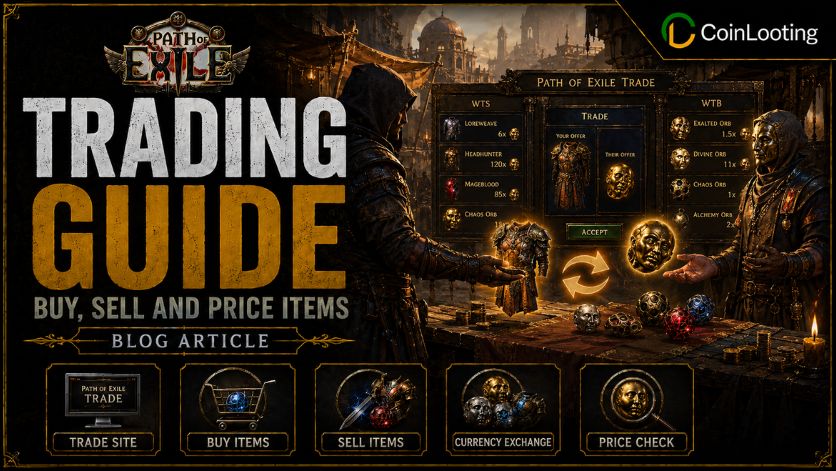
This Path of Exile trading guide covers the practical side of all three systems: finding items, reading listings, buying and selling gear, pricing drops, exchanging currency, and avoiding trades that look cheaper than they really are.
Three Ways to Trade in Path of Exile
The easiest way to learn PoE trade is to stop treating it as one system.
Different items fit different markets.
| Trading method | Best suited for | How the trade works |
|---|---|---|
| Trade Site / Trade Market | Rare gear, Uniques, gems, jewels, specific item rolls | Search listings with filters, then complete a manual or eligible instant purchase |
| Asynchronous Trade | Items listed through Merchant’s Tabs | Eligible items can be purchased directly, including while the seller is offline |
| Currency Exchange | Currency and other supported stackable items | Place exchange orders and pay the required Gold fee |
GGG added asynchronous item trading and an in-game Trade Market interface to PoE 1 in patch 3.27. The in-game interface works alongside the web-based trade system, giving players another way to search listings without leaving the game.
The Currency Exchange solves a different problem. It is built around bulk and stackable items rather than finding one Rare helmet with an exact combination of Life, resistances, and attributes.
Search for the Item You Need, Not the Perfect Item
The official Path of Exile Trade interface becomes much easier once you know what part of an item actually matters to your build.
Searching for a Unique is straightforward. Enter its name, choose the correct league, then compare the rolls that affect your character.
Rare gear requires more thought.
Instead of searching for one impossibly exact item, identify the stats the slot needs to solve. Boots might need Movement Speed and enough total resistance to fix a gap. A ring might need Life, an attribute, and one strong resistance rather than three exact resistance values.
PoE Vault’s current trading guide recommends filters for item stats, minimum and maximum values, price, league, and listing status. It also highlights pseudo filters such as Total Elemental Resistance, which can find useful combinations that an overly rigid Fire + Cold + Lightning search might exclude.
That wider search often exposes cheaper gear with the same practical value.
How to Buy an Item From Another Player
For a traditional player-to-player trade, the process remains short.
- Search for the item and set the league, stats, rolls, and price range you need.
- Check the listing carefully, including modifier values, corruption status, sockets, and price.
- Send the trade whisper from the listing.
- Accept the seller’s party invite when they respond.
- Travel to the seller’s hideout and wait for the trade request.
- Place the listed currency in the window, inspect the item again, then accept the trade.
Do not change the agreed price after arriving unless the seller made a listing mistake and raises the issue first.
Sellers do not always answer. They may be inside a Map, the item may already have sold, or the listing may simply be old. Move to another comparable listing rather than spending several minutes waiting for one response.
For uncommon items, Live Search is useful. It keeps a filtered search active and surfaces newly listed matches, which can help when a specific modifier combination rarely appears. PoE Vault includes Live Search as part of the current PoE 1 trade workflow.
Instant Purchases Changed Item Trading
Manual whispers are no longer the sole way to buy equipment in PoE 1.
Patch 3.27 introduced Asynchronous Trade. After reaching Act 6, players can meet Faustus in Lioneye’s Watch and later access him from the Hideout. Merchant’s Tabs let sellers list items for direct purchase, including when they are offline.
This creates an important distinction when browsing current listings.
A normal Premium Stash listing can still lead to the familiar whisper-and-hideout trade. A Merchant’s Tab listing can support instant purchase through the newer system.
PoE Vault’s 2026 guide reflects this change with an instant buyout only search option for players who prefer listings that do not depend on a seller responding.
For common upgrades, instant listings can save time. Manual listings remain useful when the exact item you want is unavailable through asynchronous trade or has a better price elsewhere.
Selling Items Through Premium and Merchant’s Tabs
Traditional selling still works through a Public Premium Stash Tab.
Place the item in a public Premium tab, set its price, and it can appear in trade results. When a buyer whispers you, invite them, let them come to your Hideout, then complete the transaction through the trade window. PoE Vault documents this Premium-tab method in its current PoE 1 guide.
Merchant’s Tabs serve the asynchronous system instead.
GGG introduced them for direct purchases in 3.27. Eligible older Premium Stash Tabs can be converted through the account upgrade system under the conditions listed by GGG, and the Merchant shop itself is managed through Faustus rather than appearing like a normal stash tab.
For a seller, the practical choice is straightforward:
Premium tab works for traditional listings and manual transactions.
Merchant’s Tab is built around direct asynchronous sales.
There is no need to move every item into one format. The better choice depends on the item, your available tabs, and how much time you want to spend responding to buyers.
How to Price Rare Items Without Guessing
Pricing is harder than listing.
Unique items usually give you plenty of comparable results. Rare items may have six modifiers, different tiers, fractured or crafted affixes, open slots, varying item levels, and very different value depending on the current meta.
Start by identifying the two or three modifiers that make the item desirable.
Search for those. Add minimum values that still describe your item, then look at comparable listings. If the result set is tiny, loosen one secondary requirement and search again.
Do not automatically price from the cheapest result.
The lowest listing may have been underpriced, may have worse rolls in a stat you missed, or may already be effectively unavailable. Several comparable listings give a more useful range than one result.
For Unique gear, pay attention to roll ranges. Two copies of the same Unique can differ significantly in value when one has strong values on its build-defining modifiers. PoE Vault specifically recommends comparing important rolls rather than treating every copy of a Unique as equivalent.
If an item receives whispers almost immediately from several buyers, that is often a sign that the price deserves another check before the sale is completed.
Trade Currency Depends on the Size of the Purchase
Path of Exile’s economy revolves around currency items rather than one universal trade coin. The Path of Exile Currency hub covers the main PoE 1 currencies used across trade, crafting, and gear progression. CoinLooting currently separates Chaos, Divine, and Exalted Orbs by their different economic and item roles.
For ordinary purchases, prices often make sense in Chaos Orbs. They are easy to recognize, commonly accepted, and suit many smaller gear transactions. Players who need currency for regular trades can check PoE Chaos Orbs.
Higher-value items are commonly priced around Divine Orbs. Their value in the current PoE economy makes them practical for expensive gear and major upgrades. PoE Divine Orbs fit that higher-value trade context. CoinLooting’s current Divine page identifies trade power and endgame gear purchases as central uses.
Exalted Orbs have a more crafting-focused identity in current PoE 1. They can still be exchanged like other tradeable currency, but their distinctive item function is adding a random explicit modifier to an eligible Rare item with an open affix. Players buying them for a gear project can find PoE Exalted Orbs.
Keeping those roles separate makes pricing easier. A 20-Chaos purchase and a multi-Divine upgrade belong to different parts of the same economy.
When to Use the Currency Exchange
The Currency Exchange is better suited to many repetitive bulk transactions.
Instead of whispering several sellers for one currency type, you can place an order through the exchange and specify what you have and what you want. The system requires Gold fees, and those costs can vary depending on the item being exchanged. GGG adjusted Gold fees for multiple commonly traded currencies in 3.27 and has continued changing individual costs in later patches.
This makes the exchange particularly convenient when you need stacks of crafting currency or want to convert standardized rewards from farming.
The regular Trade Site still makes more sense when the purchase is defined by item-specific modifiers rather than quantity.
Think of it this way:
Need a Rare amulet with exact stats? Search the item market.
Need a stack of currency or another supported exchange item? Check the Currency Exchange first.
That keeps trade time proportional to the value of the transaction.
Bulk Trading Can Cost More for Convenience
Bulk prices are not always identical to the cheapest individual price.
A seller holding a large quantity can charge a premium for convenience. Paying slightly more per unit may still make sense when the alternative is contacting ten sellers and completing ten separate transactions.
PoE Vault notes this bulk premium in its current trading guide.
For crafting projects, compare both sides of the decision. If you need hundreds of one currency type, the best-looking unit price may create more trade friction than a slightly more expensive bulk order.
The Currency Exchange removes much of that manual coordination, but Gold cost becomes another part of the calculation.
Farming Loot Is Only Valuable After You Sell It
Trading completes the farming loop.
A stash full of Lifeforce, Scarabs, fragments, Logbooks, Divination Cards, and spare currency may represent significant value, yet none of it pays for a new weapon until those rewards are converted into something the seller accepts.
The existing Path of Exile currency farming guide covers how Maps and league mechanics generate those rewards. Trading is the next stage: pricing the output, selling it efficiently, and converting scattered value into the currency needed for the next upgrade.
Batch sales help. Pricing every small drop after every Map creates more downtime than collecting standardized rewards and dealing with them together.
Buy the Upgrade or Craft It Yourself?
The market is useful even when you enjoy crafting.
Before committing expensive currency to a base, search for finished items with the modifiers you want. If a comparable item already costs less than the likely crafting attempts, buying it can preserve a large part of the budget.
The opposite can happen too. A finished item may carry a high premium despite having modifiers that are realistic to create from a strong base.
The decision comes down to three numbers: base cost, expected crafting cost, and market price of an acceptable finished item.
This is where trading knowledge directly improves crafting decisions. Search results tell you what finished gear is worth before you gamble currency trying to reproduce it.
Trading Mistakes That Cost Currency
A few errors account for many bad trades:
- Searching in the wrong league. Standard and the current Challenge League have different listings and economies.
- Buying the cheapest result without checking rolls. A weak modifier value can explain the lower price.
- Ignoring corruption or item restrictions. A Corrupted item may limit what can be changed later.
- Paying for stats your build does not need. More modifiers do not automatically mean a better upgrade.
- Misreading currency amounts in the trade window. Inspect both sides before accepting.
- Treating listed price as guaranteed market value. Listings are asking prices, not proof that an item sells at that amount.
- Forgetting liquidity. A theoretically expensive Rare may sit unsold much longer than a standardized currency item.
The safest habit is to slow down for expensive transactions. One extra search usually costs less than correcting a bad purchase.